History of the House
The Evolution of a Dynasty: From Imperial Origins to Modern Law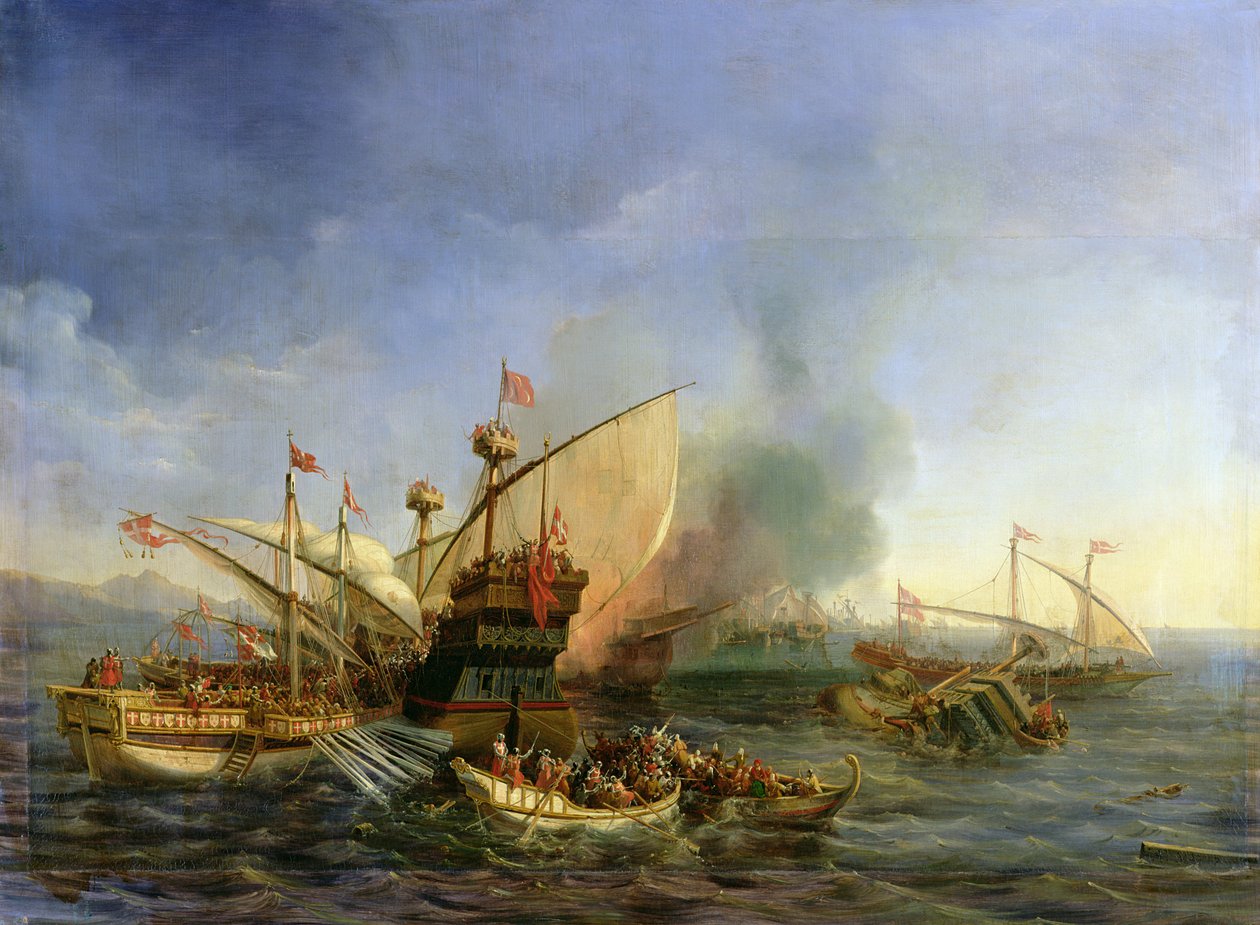 "The Battle of Episkopi, 1323" by Auguste Étienne François Mayer (1805–1890). Modern scholarship identifies the true subject of this work as the 1319 Battle of Chios, a crucial naval engagement in which Lord Martino Zaccaria and the Knights Hospitaller allied to crush the Aydinid fleet and secure the Aegean from piracy.
The history of the House of Zaccaria de Damalà is the story of a unique dynastic evolution. Establishing themselves as lords in the mid-13th century, the family fused Genoese patrician vigour with the imperial blood of Byzantium to reign as sovereigns over the Aegean and the Peloponnese. Unlike other Crusader dynasties that vanished with the loss of their lands, the Zaccaria transformed: surviving as "Co-Princes of Chios" under the Ottomans, integrating as the nobility of modern Greece, and preserving their sovereign qualitas as an incorporeal patrimony to the present day through strict observance of dynastic law.
The Imperial Union (1267–1325)
The dynasty’s rise to sovereign power began in 1267 when the family secured the Lordship of Phocaea. Their status was cemented in 1275 through a decisive dynastic union, when Admiral Benedetto I Zaccaria married the sister of the Byzantine Emperor Michael VIII Palaiologos.
This marriage formally merged the House with the Imperial bloodline. Their son, Benedetto II, adopted the double-barrelled surname Palaiologos-Zaccaria, marshalling the Palaiologos and Zaccaria arms. This laid the foundation for a dynasty that would forever straddle the Latin and Byzantine worlds.
The Kingdom of Asia Minor (1325)
 A colour-enhanced section of Angelino de Dalorto's 1325 portolan chart, focusing on the central Aegean. It was precisely in this year that Martino Zaccaria, Lord of Chios and Damalà, was granted the title of King and Despot of Asia Minor. On the map, a flag of the quartered Or and Gules (gold and red) Zaccaria arms can be seen on the coast of Asia Minor, at the port of Phocaea.
While the family ruled as Lords of Chios from 1304, their elevation to true royal rank occurred in 1325. On 24 May of that year, the Latin Emperor Philip II of Taranto and Empress Catherine II of Valois issued a Golden Bull investing Martino Zaccaria not merely as a ruler of territory, but as the King and Despot of Asia Minor.
This dignity was designed as a "Suspended Legal Polity"; a Kingdom defined by law rather than land. The Emperor legislated the Kingdom into existence by defining it by "boundaries and terms" (per fines, et terminos) rather than physical possession, creating a juridical state vested in the bloodline which exists by operation of private law to this day.
"...we create, ordain, and appoint the said Lord Martino as King and Despot of the said Kingdom of Asia Minor... and to his heirs of both sexes born and to be born from his legitimate body... giving the power to drink in gold, wear crowns and sceptres, and red boots... and enjoy all and singular dignities, honours, and prerogatives which befit a royal and despotic dignity... in perpetual feudal nobility."
— Imperial Diploma of 1325
The Principality of Achaea and the Barony of Damalà (1346–1404)
 The Morea as seen on a 1522 map of Greece and part of the Balkans by Lorenz Fries (1490–1531), where the Argolid Peninsula was known as the region of Damala, from the time of the Barony of Damalà of Achaea, into the 20th century.
Following a period of imprisonment by the Byzantines, King Martino was released by Papal intervention to lead the Crusade of Smyrna, where he was martyred and beheaded at the cathedral altar in 1345. Displaced from the Aegean after the Genoese Maona seized Chios the following year, the dynasty shifted its centre of gravity to the Peloponnese. Through Martino's marriage with the heiress of the De la Roche, Dukes of Athens, the family had acquired the strategic Barony of Damalà. This fief became the family’s seat of power and the source of their territorial identifier, Zaccaria de Damalà.
The dynasty further solidified its imperial connections through Centurione I Zaccaria’s marriage to a daughter of Andronikos Asen (grandson of the Bulgarian Tsar and Irene Palaiologina). Consequently, this, and the marriage of his grandson, Centurione II, to another Asenina-Palaiologina, led the family to adopt the additional surname Asen (or Asanes) for three generations.
In 1404, the family achieved the apex of their territorial power. Prince Centurione II Zaccaria purchased the dominium plenum (full sovereignty) of the Principality of Achaea from the Kingdom of Naples. This transaction transformed the Principality from a vassal fief into an independent, allodial sovereignty (dominium plenum) vested directly in the Zaccaria bloodline.
Restoration and Exile (1453–1469)
 Detail of Pinturicchio’s fresco Pius II Arrives in Ancona (Piccolomini Library, Siena). Long misidentified due to 19th-century cataloguing errors as "Hassan Zaccaria", the kneeling figure in the white turban is actually Prince John Asen Zaccaria, pictured beside his ally, the Doge of Venice. The Prince physically accompanied Pope Pius II to Ancona in 1464, retaining his sovereign recognition throughout his exile.
Though Centurione II was besieged inside the castle of Chalandritsa in 1429 and forced under duress to cede the physical territory to Thomas Palaiologos, dying in 1432, the sovereign title remained with his legitimate heirs.
The Sovereign Restoration (1453–1455): In 1453, the Principality was restored under Centurione’s son, John Asen Zaccaria (proclaimed Prince Centurione III). He was recognised as a reigning sovereign by Pope Nicholas V, Venetian Doge Francesco Foscari, and King Alfonso V of Naples; the latter formally pledged to "defend his state" (ad tutandum statum vestrum).
The Prince in Exile (1455–1469): Following the final collapse of the Frankish East, John retained and expanded the recognition of his sovereign rank with the Republic of Genoa and the Duchy of Milan. In 1461 he was received in Rome by the Holy See as the legitimate Prince of Achaea, establishing for the lineage an enduring diplomatic precedent of recognition by the Papacy that has never been revoked.
The Return to Chios (1566–1822)
 An 18th-century armorial roll depicting the heraldry of the families inscribed in the Libro d'Oro of Chios. During this era, Ottoman administrative policies increasingly favoured Greek-Orthodox families over those of Latin-Catholic descent, prompting a gradual shift in the island's political and confessional demographics.
The dynasty did not vanish; it returned home. In 1566, Antonio Damalà returned to Chios at the invitation of the Ottoman administration. There, the family integrated into the Libro d'Oro nobility, a class that functioned as a "State within a State".
During this period, the Damalà maintained strict dynastic parity with the princely Giustiniani family—the former rulers of the island—through generations of intermarriage. As members of this ruling caste, they shared in the status acknowledged by the French Crown, which historically addressed the ruling class of Chios as "Princes of Scio". It was on Chios that the line maintained their Latin identity as Damalà for centuries. This era ended tragically during the 1822 Chios Massacre, when the island's governor, Ioannis Zanni Damalà, was executed alongside other nobles. The surviving family was forced to flee to the mainland, fully Hellenising their name to Damalas.
The Kingdom of Greece and Royal Proximity (1822–1925)
The ancestral rank of the lineage was acknowledged in the early years of the Kingdom of Greece, when King Otto I and Queen Amalia were hosted at the Damalas palace in Ermoupoli, Syros, as private guests of Ambrosios Damalas in 1846 and again in 1850. These royal visits occurred years prior to his first appointment by the Crown as Mayor of the country's most important city of the time, confirming their retained status independent of political office.
 Pavlos I wearing the insignia of a Commander of the Royal Victorian Order, the Order of the Redeemer, and the Order of Charles III, among others.
This intimacy with the Royal House continued into subsequent generations. Pavlos Damalas introduced cycling to Greece alongside King George I in 1869 and secured a foundational Royal Charter for the Ereto Rowing Club in 1885, of which Crown Prince Alexandros was an active member, and continues to exist as the oldest sporting institution in Greece and the Balkans. His standing within the court circle was such that in 1903 he was able to appeal his election dispute directly to Crown Prince Constantine.
International recognition of the family's status was equally definitive. Pavlos was appointed Honorary Vice-Consul of the Kingdom of Spain in Greece, and invested as a Commander of the Royal Victorian Order (CVO) by King Edward VII. His marriage to the daughter of the 2nd Duke of Tascher de La Pagerie, united the House with the ducal lineage of Empress Josephine. This dynastic parity was further acknowledged by the Russian Empire; Aristides (Jacques) Damalas, was admitted to the Imperial Corps des Pages by personal appointment of the Tsar—an honour strictly reserved for the highest nobility of Russian lands. He later married the legendary actress Sarah Bernhardt in Paris, and his striking, aristocratic demeanour famously served as a primary model for Bram Stoker's iconic character, Count Dracula.
The resilience of this status was perhaps most visibly demonstrated by Aristides’ daughter, Tereza. Despite the circumstances of her birth, she was fully integrated into the Athenian Royal Court, moving with King Constantine I into exile. Her lineage inspired the Italian poet Gabriele D’Annunzio to compose the Song of the Dardanelles in honour of her ancestor King Martino Zaccaria, while literary contemporaries like Ernest Hemingway simply referred to her as "The Greek Princess"—a testament to the enduring aura of the dynasty.
The Diaspora and the Dormancy (1925–2017)
Following the death of Pavlos Damalas in 1925, the succession of the House entered a period of historical obscurity. A chain of tragedies had removed the primary heirs in Greece, leaving the headship to the senior male line descended from Pavlos’ first cousin, Ioannis Athanasios Damalas. However, Ioannis had emigrated to the United States in the early 20th century, and amid the global upheavals of World War I and the Greco-Turkish War, contact between the diaspora and the homeland was severed.
In the absence of the rightful heirs, the senior line was wrongly presumed extinct by contemporaries in Greece. Consequently, the representation of the family devolved de facto to a cadet branch, while the sovereign rights of the House lay dormant, preserved within the American line. This period of silence ended in the 21st century, when forensic genealogical research definitively re-identified the senior lineage and restored the rightful order of succession.
Contemporary Status
Today, the Head of the House is Prince Constantine II, representing the restored senior line. Under his tenure, the House has emerged from its century of dormancy into an era of active renewal. The family’s historical rights and lineage have been fully verified and registered by modern genealogical authorities, while forensic legal scholarship has confirmed the survival of its sovereign qualitas as a self-contained, incorporeal patrimony.
Rather than treating this heritage as a mere academic abstraction, the House exercises its historical prerogatives as a living, modern entity. This is most visibly demonstrated by the recent promulgation of codified House Laws, the resumption of active patronage and official civic engagements within the Hellenic world, the formal revival of the Principality's historical chivalric institution, the Order of the Hospital of Saint James in Andravida, and the forging of international humanitarian alliances—most notably through its covenant of amity and dynastic protection over the Holy Orthodox Order of Saint George the Great Martyr. Honouring its unique legacy as a bridge between the Catholic and Orthodox religious spheres—a dual heritage affirmed by the House's modern recognition and formal ecclesiastical ties with hierarchs of both Churches—the House remains dedicated to the preservation of its historical memory and the execution of charitable works across the Christian East.
Dynastic Succession
Trace the unbroken 800-year lineage of the House of Zaccaria de Damalà, from the early Lords of Chios to the present day.
Explore the Interactive Family Tree