Juridical Status
Sovereignty • Legitimacy • International Law
Statement of Juridical Quality
"By legally granting the right to wear a crown and exercise royal dignity immediately and everywhere, completely divorced from the clause that required the actual conquest of the territory, the Emperor objectively created a portable, non-territorial legal vessel. He legislated a 'Kingdom' that existed on the body of the King, rather than on the soil of Asia Minor. This single textual reality proves without question that a third category—an incorporeal sovereign dignity existing sine imperio—was the deliberate, original legal design of the grant."
The dynastic status of the House of Zaccaria de Damalà presents a unique paradigm in international dynastic law. Traditional historiography frequently attempts to evaluate the House's historical trajectory using the restrictive metrics of modern Westphalian statehood—demanding uninterrupted territorial control and continuous diplomatic gazetting. However, to judge the dynasty's legacy by these modern standards is a fundamental category error. The historical reality of the House rests on a sui generis legal situation, comprising a non-territorial Kingship and an allodial Principality, both of which must be assessed forensically by the specific Roman, feudal, and dynastic jurisprudence under which they were originally engineered and preserved.
The validity of these claims operates securely within the protective sphere of international private law, resting on three unassailable legal foundations:
I. The 1325 Diploma
The textual proof of non-territorial creation. By deliberately severing the sovereign dignity from physical possession, the Latin Emperor engineered a structural legal vessel operating completely independent of the soil.
II. The Continuity (Qualitas)
The Roman property law protection of the bloodline. Established as an incorporeal property right (res incorporalis), the sovereignty remained structurally immune to territorial conquest (debellatio) or political erasure.
III. Modern Execution
The application of international private law to protect the family's internal governance, enabling the Head of the House to actively execute the dynasty's unextinguished fount of honour (fons honorum) today.
The Kingship of Asia Minor: A Sui Generis Creation
On 24 May 1325, the Latin Emperor Philip II of Taranto and Empress Catherine II of Valois conferred the dignity of King and Despot of Asia Minor upon Martino Zaccaria. A common critique attempts to diminish this diploma by arguing that Philip II was merely a "titular pretender" without possession of Constantinople. This ignores the constitutional reality of the era. The Latin Empire had not evaporated; it persisted as a rump state centred in the Morea, with successive Latin Emperors reigning directly as Princes of Achaea, effectively making the Principality the de facto seat of the Empire. Consequently, Philip II was not issuing empty honours in exile, but acting as a reigning monarch exercising genuine legal authority and feudal initiative from his active domain in the Peloponnese.
Modern jurisprudential analysis establishes an analytical framework delineating three distinct categories of sovereign entities in legal history:
Polities exercising active, uninterrupted physical control over defined geographic territory.
Former territorial rulers dispossessed of land, whose ongoing status relies heavily on continuous public memory, political relevance, and external diplomatic recognition.
A sui generis legal category established by the 1325 Diploma—a non-territorial entity created sine imperio as a portable legal vessel (res incorporalis), existing perpetually on the person or bloodline rather than the soil, rendering it structurally immune to territorial conquest (debellatio) or political erasure.
While orthodox historiography frequently attempts to misclassify the 1325 grant as a Category 2 aspirational promise that expired when physical territory was lost, forensic analysis demonstrates that the diploma was deliberately engineered as a Category 3 creation—a groundbreaking exercise in non-territorial state-building.
A Kingdom on the Body of the King
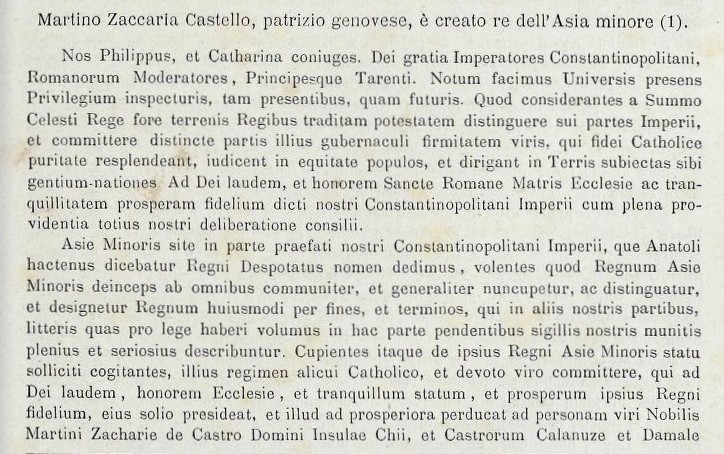 The opening portion of the transcribed 1325 Imperial Diploma granting the Kingship and Despotate of Asia Minor to Martino Zaccaria, as recorded in Camillo Minieri-Riccio's Saggio di codice diplomatico (1882).
In a standard territorial royal grant, the title and the land are one and the same: if you do not conquer the land, you do not receive the title. However, the 1325 Diploma deliberately split the grant into two completely separate legal conditions.
The contingent condition—the military obligations to furnish knights and galleys—was explicitly attached to the realiter possessionem adepti clause; it only activated if and when the physical territory was conquered. Conversely, the immediate condition—the dignitas, the right to wear the crown, sceptre, and red boots—was granted immediately, perpetually, and was explicitly authorised to be exercised everywhere ("ubique extra Palatium").
By legally granting the right to wear a crown and exercise royal dignity immediately and everywhere, completely divorced from the clause that required the actual conquest of the territory, the Emperor objectively created a portable, non-territorial legal vessel. He legislated a "Kingdom" that existed on the body of the King, rather than on the soil of Asia Minor. This single textual reality proves without question that a third category—an incorporeal sovereign dignity existing sine imperio—was the deliberate, original legal design of the grant.
By immediately conveying the structural slots of governance—specifically counties and baronies ("Comitatibus, Baroniis"), jurisdictions ("iurisdictionibus"), and the immediate, unrestricted grant of all and singular dignities, honours, and prerogatives that befit a royal and despotic dignity ("omnibus, et singulis dignitatibus, honoribus, et prerogativis, quae decent regalem, et despotalem dignitatem"), alongside the physical regalia of the crown, sceptre, and red boots ("coronam, et sceptrum, ac caligas rubeas")—the imperial act explicitly endowed the dynasty with the right to create nobility (Jus Nobilitandi), the right to appoint state officers (Jus Officii), the right to administer justice (Jus Dicere), and the rights of majesty (Jus Majestatis) as an active legal framework before any land was secured.
Because this sovereign quality was explicitly severed from territorial dominion, the Kingship was established literally as an incorporeal property right (res incorporalis). Therefore, evaluating this dignity requires the application of Roman property law, as it is the only jurisprudential framework designed to govern such an incorporeal hereditament. A King who does not require a throne to reign cannot be dethroned; his status is an inalienable quality of his person.
The Allodial Sovereignty of Achaea & The 1404 Confusio
While the Kingship of Asia Minor was a non-territorial creation, the Principality of Achaea was a distinct territorial reality. Because it originated as a vassal fief of the Kingdom of Naples, critics frequently argue that the Neapolitan Crown retained the right to revoke and re-grant the title.
This ignores the fundamental constitutional shift of 1404. Prince Centurione II Zaccaria did not merely receive investiture; he purchased the full rights to the Principality from King Ladislaus of Naples. This transaction united the dominium directum (feudal superiority) with the dominium utile (possession). Crucially, Centurione II simultaneously absorbed the residual Angevin claims to the Latin Empire itself, assuming the imperial dignity of Despotus Romaniae.
Under the Roman law doctrine of Confusio (the merger of debtor and creditor in the same person), uniting the vassal and suzerain into a single juridical person extinguishes the feudal obligation by operation of law. The overarching sovereign root did not collapse with the Latin Empire; it was permanently internalised into the Zaccaria bloodline, instantly emancipating their royal prerogatives into a fully independent, supreme fount of honour (fons honorum).
Orthodox nobiliary critics frequently err by treating the Zaccaria titles as severable assets, arguing that the territorial conquest of Achaea extinguished its specific dignity regardless of the family's other holdings. This ignores the mechanics of the unified dynastic estate (majorat) and the jurisprudence of sovereign capacity. To lawfully maintain a territorial title in pretence, a claimant must possess the inherent capacity of a sovereign (qualitas). If a purely territorial ruler is dispossessed, their sovereign capacity is extinguished by complete territorial defeat (debellatio), legally degrading them into a private citizen. However, because the territorial Principality of Achaea was fused into a majorat with the Kingship of Asia Minor—a dignity explicitly constructed without territorial dominion to generate the rights of majesty independent of land—the Head of the House never suffered a legal degradation of status. The incorporeal Kingship perpetually sustains the heir's capacity as a sovereign peer, providing the exact legal jurisdiction required to lawfully maintain and assert the territorial title of Prince of Achaea as an active title of pretension.
Likewise, because Naples had permanently sold its allodial rights to the Zaccaria in 1404, the later 1642 grant of the title of "Prince of Achaea" by the Spanish/Neapolitan Crown to Antonio Tocco was a "new creation" ex nihilo within the Neapolitan nobility. It served merely as a secondary nobility dignity to the Tocco Princes of Montemiletto, was conditional upon the forfeiture of sovereign pretensions, and represented a completely distinct, non-sovereign legal object from the ancient dignity of the Zaccaria.
The Invalidity of Rival Claims
The most prominent historiographical narrative asserts that the Principality legally passed to the Byzantine Despotate of Morea in 1429, and subsequently to the Tocco family. When subjected to Roman law, Achaean constitutional law, and diplomatic scrutiny, these rival claims are definitively invalidated.
The Principle of Metus (Duress)
Prince Centurione II was forced to sign the 1429 treaty ceding the Principality to John Asen's cousin, Thomas Palaiologos, while held in captivity and subjected to physical mutilation. Under Roman Law, the principle of metus nullifies any contract signed under fear of death or bodily harm. This specific standard was previously affirmed as an internal dynastic precedent for the Zaccaria in 1343, when Pope Clement VI officially ruled that oaths sworn by Martino Zaccaria while in Byzantine captivity were legally void because they were extracted "by the force of imprisonment". Therefore, the coerced 1429 cession was void ab initio, and the sovereign rights remained firmly vested in Centurione’s free heir, John Asen Zaccaria.
The Assizes of Romania and the Agnatic Mandate (Salic Law)
Second, even if the cession were not coerced, it explicitly violated the Assizes of Romania (the constitution of Frankish Greece). Rule 32 mandated strict absolute primogeniture. Because Centurione's legitimate son, John Asen Zaccaria, was the elder first-born, skipping him to transfer the rights to a younger daughter, Catherine, was legally impossible. Furthermore, Rule 31 strictly forbade a liegewoman from marrying an enemy of her lord, rendering Catherine's marriage to the invading Despot of Morea legally void for the purposes of feudal succession.
More importantly, the succession of the House is governed by its own internal Lex Familiae. The Zaccaria dynasty historically enforced strict Salic law (agnatic primogeniture) across their patrimony. This agnatic custom was explicitly validated by the Neapolitan Crown in 1404, when King Ladislaus deposed Princess Maria II Zaccaria specifically for failing to uphold male succession rights. Because the Tocco claim relies entirely on illegal female-line descent from Catherine Zaccaria, it is completely void under the enforceable dynastic law of the era.
Debunking the Myth of Illegitimacy
In the 19th century, the historian Carl Hopf introduced the narrative that John Asen Zaccaria was an illegitimate son—a fabricated assumption unsupported by primary evidence, typical of his occasionally sloppy genealogical inventions as noted by modern scholarship. This myth is forensically dismantled by primary diplomacy:
- Imperial Cognomen: John Asen consistently used the imperial surname 'Asen' (or Asanes) in official diplomatic correspondence, an act legally incompatible with bastardy given the rigid protection of imperial dynastic assets.
- Sovereign Parity: His marriage to Maddalena Tocco—sister of Constantine XI's wife—functioned as a contemporary "peer review", as a high-born princess would never be given in marriage to an illegitimate son.
- Genoese State Tribute: In 1448, the Republic of Genoa paid formal tribute to John's son, Angelo, explicitly honouring him as the "grandson of Achaean Prince Centurione II", an independent audit confirming the unbroken legitimacy of the line before the 1453 restoration.
The 1455 Tocco Estoppel
The competing Tocco claim is legally barred by the diplomatic conduct of their own lineage. In 1455, Leonardo III Tocco, Despot of Epirus, acted as a diplomatic intermediary and formally addressed John Asen Zaccaria as the legitimate Prince of Achaea (Prince Centurione III). Under international law, this constitutes binding estoppel; by formally validating the Zaccaria sovereign status, the Tocco effectively severed and invalidated their own descendants' 1642 pretension to the exact same title.
Sovereign Restoration and Exile (1453–1469)
History frequently dismisses the end of the Frankish Morea as a definitive collapse following the 1429 capitulations. In reality, the sovereignty of Achaea was actively restored and internationally recognised.
During the Great Morean Revolt of 1453, John Asen Zaccaria successfully revived the Principality at Aetos. His rule was not viewed as a mere rebellion; during this brief rule, he was formally recognised as a sovereign ally by King Alfonso V of Naples, who explicitly pledged to "defend your state" (ad tutandum statum vestrum), as well as by the Republic of Venice and Pope Nicholas V. Following the final Ottoman advance, this sovereign status was definitively preserved in exile. From 1455 to 1469, John Asen was formally recognised and financially sustained as the legitimate Prince of Achaea by the Republic of Genoa, the Duchy of Milan, and two successive Roman Pontiffs (Popes Pius II and Paul II).
Perpetuity of Rights: Delineating Survival Mechanisms
To understand the unextinguished nature of the dynasty's prerogatives, it is legally vital to recognise how these dignities operate as a unified dynastic estate (majorat):
- The Kingship and Despotate of Asia Minor: Because this dignity was explicitly constructed sine imperio (without physical domain), it was established literally as an incorporeal property right (res incorporalis). Therefore, its historical dormancy is evaluated under Roman civil and property law, not public international law. Under this framework, the family’s centuries-long inability to publicly use their titles due to Ottoman persecution and strict Hellenic constitutional bans is absolutely shielded by the maxim Contra non valentem agere nulla currit praescriptio (prescription does not run against those unable to act). Furthermore, the specific silence of the senior line during the 20th-century diaspora invokes the protection of another foundational Roman civil law principle: Ignorantia facti excusat (ignorance of fact excuses), as geographic isolation prevented them from knowing the dynastic rights had devolved to them.
- The Principality of Achaea: As a territorial title, it was physically lost. However, because it was fused into a majorat with the Kingship of Asia Minor, the Head of the House never suffered a legal degradation of status (debellatio). It is precisely this surviving, non-territorial capacity of the Kingship that provides the legal jurisdiction required to lawfully maintain and assert the Principality of Achaea as an active title of pretension.
While the Principality of Achaea presently operates as a title of pretension following its territorial loss, its underlying sovereign capacity (qualitas), sustained by the incorporeal architecture of the Kingship of Asia Minor, does not require the validation of public international law, nor the approval of private chivalric commissions operating outside their jurisdiction. The rights persist perfectly intact within the domain of international private law, structurally immune to the rigid, territorial checklists of the modern era.
Overcoming Debellatio and De Jure Mediatisation
When the family returned to Chios at the invitation of the Ottomans to reclaim their ancestral lands following the 1566 conquest of the Aegean, they did not dissolve into the subject population. The 1566 Imperial Firman granted Chios the status of a semi-autonomous vassal republic. Inducted into the Libro d'Oro, the family retained a highly codified corporate sovereignty. They were legally exempted from standard Islamic dhimmi restrictions, preserving the "Right of the Sword" (ius gladii), the power of High Justice, and holding their estates in allodial fee simple tenure—immune to the arbitrary confiscation typical of Ottoman miri (state land), among many other privileges.
This constitutes a formal, treaty-protected de jure mediatisation that preserved their sovereign qualitas. This status was so resilient that even under continued Ottoman rule, collateral branches reconstituted the Nobility of Chios in 1859, while the senior line maintained their prominence through the catastrophe of the 1822 Chios Massacre. Following the execution of Ioannis Zanni Damalà, the island's governor, the surviving family fled to the Cyclades, specifically to Ermoupoli on the island of Syros, carrying their inherent qualitas with them.
Onomastic Distinction and Genealogical Integrity
Because the name was Hellenised to "Damalas" following the 1822 massacre, confusion occasionally arises with unrelated, indigenous Greek families of Byzantine-Orthodox origin bearing the same toponymic surname. However, authoritative historians, including George Zolotas, explicitly distinguish between the indigenous 'Greek house' and the 'Frankish house' (φραγκικόν) descended from the Zaccaria lords of Chios. While the Frankish line eventually adopted the Orthodox faith and Greek identity upon their flight to the Cyclades, archival entries prior to 1822 strictly differentiate the noble line through confessional and onomastic markers, appearing exclusively with Catholic affiliation and Italian forenames (e.g., Antonio, Francesco, Giovanni). This distinct, unbroken descent is authoritatively attested by Philip Argenti's Libro d'Oro de la Noblesse de Chio and Professor Dionysios Zakythinos.
Constructive Mediatisation in the Hellenic Kingdom
Because modern Greek constitutions expressly banned nobility titles, the family integrated into the Kingdom of Greece without formal statutory gazetting. Instead, the Greek Crown engaged in a protocol of what could best be called constructive mediatisation. In the rigid etiquette of 19th-century courts, monarchs did not lodge with commoners merely for convenience; such intimacy was a prerogative reserved for social equals. By purposefully bypassing sitting civic authorities to lodge privately at the residence of the younger, then-untitled Ambrosios Damalas in 1846 and 1850, King Otto I performed a constructive recognition of the family's pre-existing Ebenbürtigkeit (dynastic parity). Crucially, these royal visits occurred years before Ambrosios would be appointed by the King himself as mayor of Greece's most important city—a position of absolute viceregal trust.
This fraternal equality continued for nearly a century. The family's inherent qualitas was demonstrated through a vast range of engagements with the Crown, ranging from introducing the first bicycles to Greece alongside King George I in 1869 to securing a Royal Charter for the Ereto Rowing Club in 1885 alongside Crown Prince Alexander, and collaborating with Prince George to organise the 1896 Olympic watersports. The family's qualitas seamlessly transitioned into the courts of the new regime.
The Supreme External Audit: The Corps des Pages
The ultimate public law evidence of their unextinguished dynastic rank occurred in the late 19th century when Aristidis (Jacques) Damalas was admitted to the Imperial Russian Corps des Pages. Because the Damalas lacked a position in the Russian Table of Ranks, this admission bypassed the statutory "Zone of Exclusion" and required a rigorous "Equivalence Test" and a "Personal Appointment of the Emperor". By granting this, the Russian Tsar officially categorised the Damalas lineage as Foreign Princely Nobility, proving their dynastic parity remained actively recognised by one of the Great Powers of Europe.
The Modern Assertion of Right
Following the death of the family's senior representative in Greece in 1925, the true senior line became geographically isolated in the diaspora. Because the rightful heir had emigrated to the United States and lost contact with the homeland, a local cadet branch assumed the perceived headship of the family in Greece. The historical silence of the senior line during the 20th century is entirely protected by the aforementioned civil and dynastic principle of ignorantia facti excusat.
Since 2023, following rigorous verification, the unbroken agnatic line continues under the current Head of the House, Constantine Paul Zaccaria de Damalà. The family's enduring historical eminence was recently reaffirmed in 2026, when the Hereditary Prince Martino was baptised at the heavily protected 11th-century Nea Moni monastery in Chios, and the Head of the House was formally received by the Municipality of Syros-Ermoupoli, officially recognised in civic protocol as the descendant of the last Latin Princes of Achaea.
It is within this active, present-day context that the dynasty has transitioned into a modern legal entity. By anchoring the autonomous family community within the House Laws of 2025, the Head of the House operates precisely within the protective sphere of international private law, exercising the unalienable, imprescriptible fons honorum perpetually vested in the Zaccaria bloodline.
The Right of Patronage (Jus Patronatus)
The regalian prerogatives of the House also extend to the historical chivalric institutions of the Principality. The Order of the Hospital of Saint James in Andravida was founded circa 1210 by Prince Geoffrey I of Villehardouin and granted solemn privileges by the Papal Legate in 1215 and Pope Honorius III in 1218.
Historical scholarship confirms that the secular Jus Patronatus (Right of Patronage) was fiercely guarded and exercised by the Princes of Achaea to protect, govern, and restructure the institution. Prince Geoffrey II explicitly invoked this right in 1237 to transfer the Order's administration to the Teutonic Knights, while his successor, Prince William II, subsequently redirected it to the Templars in 1246 and established the church as the dynasty's sovereign mausoleum. Even after the suppression of the Templars, Princess Margaret of Villehardouin continued to exercise these patronal rights to endow and manage the hospital in 1314.
Because the original institution became dormant in its administrative capacity but remained extant in its spiritual and dynastic right, the Head of the House does not claim to canonically resurrect a suppressed religious order. Rather, the Prince exercises this inherited Jus Patronatus in conjunction with the inherent fons honorum—derived directly from the 1325 Imperial Diploma's explicit grant of "honoribus" (jus honorum) and "prerogativis"—following the exact historical precedent of his sovereign predecessors, to reconstitute the institution of Saint James as a dynastic confraternity and chivalric institution. This legal distinction strictly aligns with international nobiliary law, anchoring the modern Order in a secular, dynastic prerogative operating within the sphere of international private law, which survived the loss of the physical territory.
Primary Evidentiary Sources
The following historical documents constitute the legal basis for the House's claims.
Issued by Latin Emperor Philip II of Taranto and Empress Catherine II of Valois. The constitutive act establishing the non-territorial dignity and transferring all sovereign prerogatives (jura majestatis) to the Zaccaria dynasty in perpetuity.
View 1882 ArchiveRecords the sale of the full rights of the Principality of Achaea to Centurione II Zaccaria by King Ladislaus of Naples, converting the Principality from a feudal fief into the allodial property of the dynasty.
(Archival summaries preserved prior to the 1943 destruction of the Naples State Archives).Issued by Pope Clement VI. A binding legal precedent establishing that sovereign oaths and cessions made under the duress of imprisonment are null and void. This ruling provides the jurisprudential basis for invalidating the coerced 1429 cession of Achaea.
Issued by King Alfonso V of Naples. Formally recognises John Asen Zaccaria as "Prince Centurione III" following the 1453 restoration, confirming his status as a sovereign ally rather than a subject.
View 1902 ArchiveContemporary Jurisprudential Analysis
The unique non-territorial legal architecture of the House has recently been forensically examined within broader academic literature, serving as the primary historical case study for the structural governance of modern Decentralised Autonomous Organisations (DAOs).
By Ugo Stefano Stornaiolo Silva. Published in The Evolution of Roman Law as an Inspiration for the Modern Legislator in the Era of Artificial Intelligence: New Perspectives in Contract Formation VOLUME II (2026). This peer-reviewed study analyses the 1325 Imperial Diploma creating the Kingdom of Asia Minor as a sovereign res incorporalis, applying its unique non-territorial legal architecture as a historical blueprint for the governance of modern Decentralised Autonomous Organisations (DAOs).
Download PDF