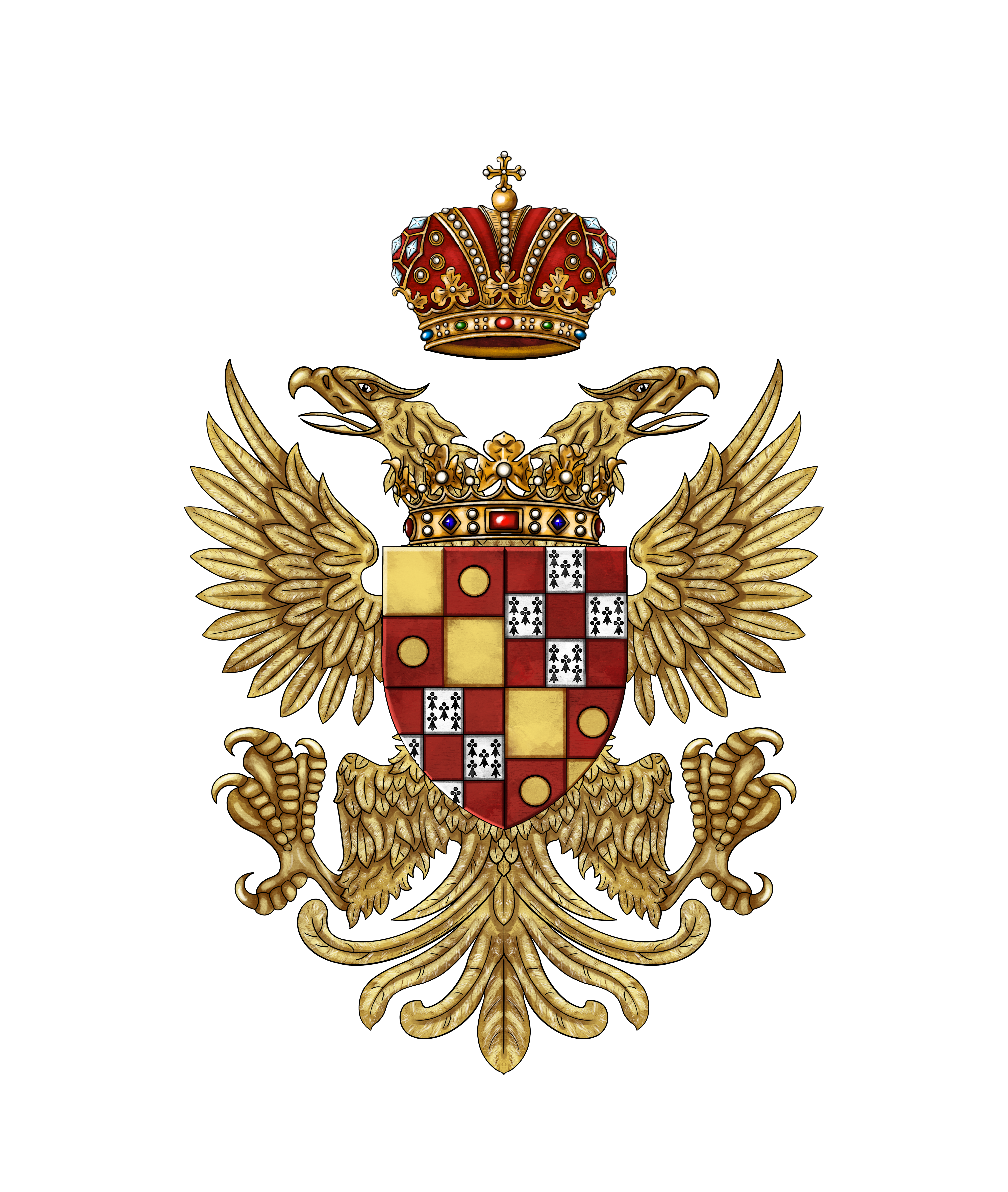
 The Grand Armorial Achievement of the House of Zaccaria de Damalà.
On the 24th of May 2025, marking exactly seven hundred years since the Latin Emperor Philip II of Taranto and Empress Catherine II of Valois issued the 1325 Imperial Diploma elevating Martino Zaccaria to the sovereign dignity of King and Despot of Asia Minor, His Royal Highness Prince Constantine II formally promulgated the new private House Laws.
Crucially, this promulgation is not a self-styled modern invention, but the direct, lawful execution of surviving historical prerogatives. The 1325 Imperial Diploma explicitly endowed the dynasty with a non-territorial sovereignty (a res incorporalis) that legally conveyed the full Jura Majestatis (rights of majesty). By expressly transferring the rights of jurisdiction and honour, the imperial decree vested the dynasty with the Jus Dicere (the right to administer internal justice), the Jus Officii (the right to appoint state officers), the Jus Nobilitandi (the right to create nobility), and the Jus Honorum (the right to confer orders and honours). Because these sovereign rights were granted completely independently of physical territorial control, they survive perfectly intact today by operation of the original grant, providing the exact legal jurisdiction required to enact these House Laws.
For centuries, the Zaccaria family—across its Genoese, Spanish, and Greek branches—had been governed by the diverse local laws and unwritten dynastic customs of the realms they inhabited or ruled. However, these medieval provisions had become increasingly obscure over time. In their fragmented state, they no longer served their purpose in an interconnected, modern world.
This extraordinary septcentenary presented the definitive catalyst to bring the dynasty out of the historical dormancy it underwent during the 20th century, following the death of its last publicly active Head in 1925. By formally reorganising the family into a structured dynastic and corporate entity through these House Laws, the House is now optimally positioned to conduct its cultural preservation initiatives and effectively meet its modern philanthropic missions.
A central pillar of the newly codified text is the formal reaffirmation of the dynasty's historical adherence to the Salic Law. Following the exact precedents of the Frankish Assizes of Romania and the agnatic customs formally validated by the Neapolitan Crown in 1404, the House Laws dictate that succession to the Headship of the House is strictly limited to agnatic (male-line) primogeniture. Furthermore, the document enshrines the Christian and Apostolic faith—specifically in its Roman Catholic and Greek Orthodox forms—as the guiding moral principle for all future decisions of the House.
In addition to clarifying succession, the text comprehensively organises the juridical framework governing the dynasty's internal affairs. It meticulously outlines the protocols for titles, styles, and armorial bearings, while establishing the House Council to assist the Prince in his duties. The document also formally regulates the administration of the Royal and Princely Household, paves the way for the revival of the historic chivalric institution of the Principality of Achaea—the Order of the Hospital of Saint James in Andravida—and institutes an entirely new dynastic decoration to reward modern service and loyalty: the Zaccaria Cross, modelled directly from the family's famous holy reliquary of the True Cross bearing the same name.
The promulgation of these laws, alongside the launch of the House's official digital presence and public archives, signals a new era. By reorganising the House upon this monumental anniversary, the Prince of Achaea has ensured that the sovereign qualitas of his ancestors operates once again as an enduring, visible reality.