The Household Circular
Communiqués • Decrees • Historical Reflections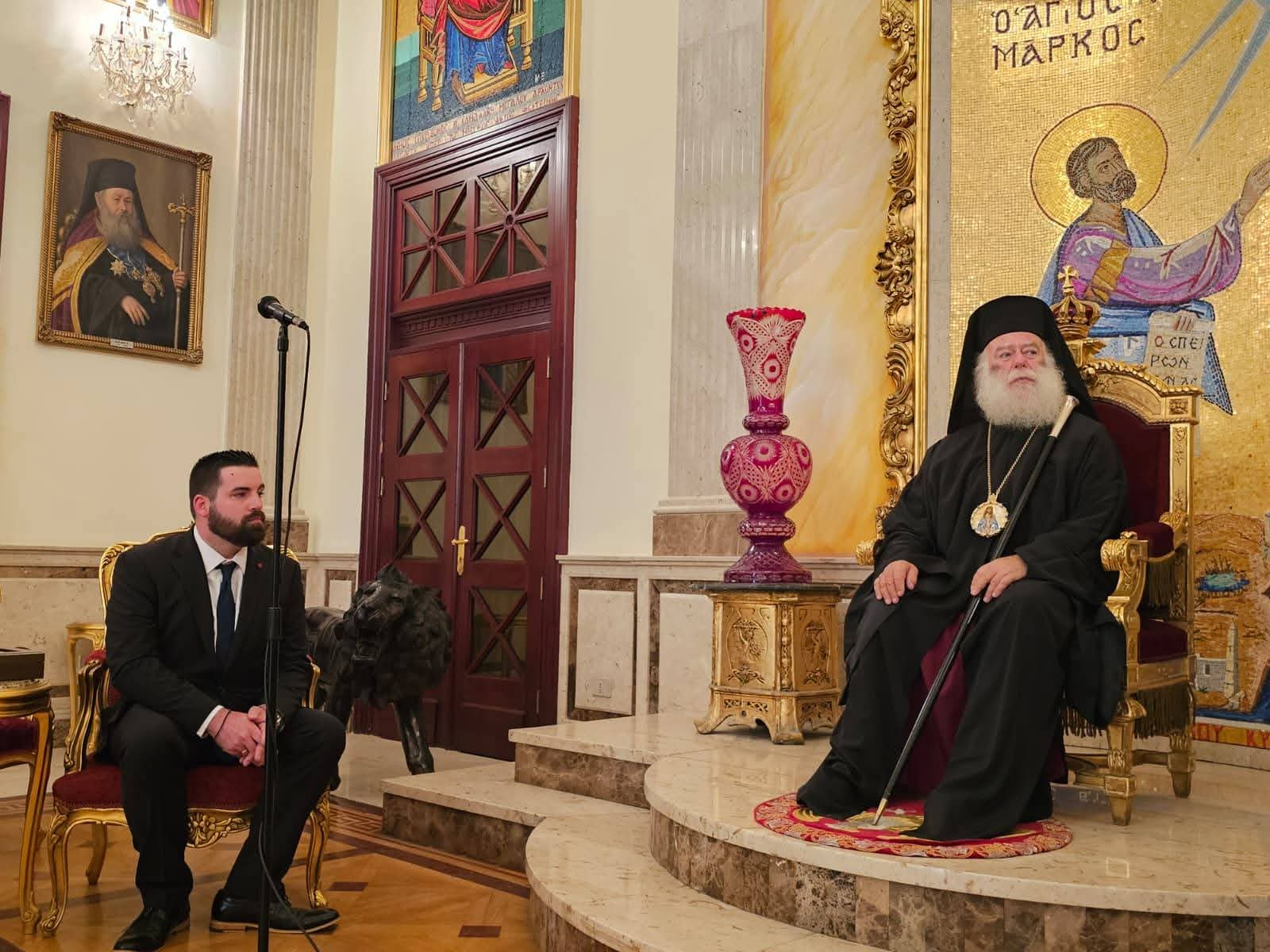
Patriarch Theodoros II of Alexandria Assumes Spiritual Guardianship of the Order of Saint George
During the Order’s official pilgrimage to Egypt, His Divine Beatitude Theodoros II, Pope and Patriarch of Alexandria and All Africa, accepted the mantle of Supreme Spiritual Guardian of the Order and presided over the Patriarchal Liturgy bearing its Grand Cross insignia.
Read MoreLetters Patent Issued Investing the Prince as Knight Grand Collar of the Order of Saint George
Solemn Letters Patent issued under the hand of the Grand Knight formally ratify the constitutional provisions of the August covenant, investing the Head of the House with the supreme rank of Knight Grand Collar and confirming his hereditary office as Royal Protector.
Read More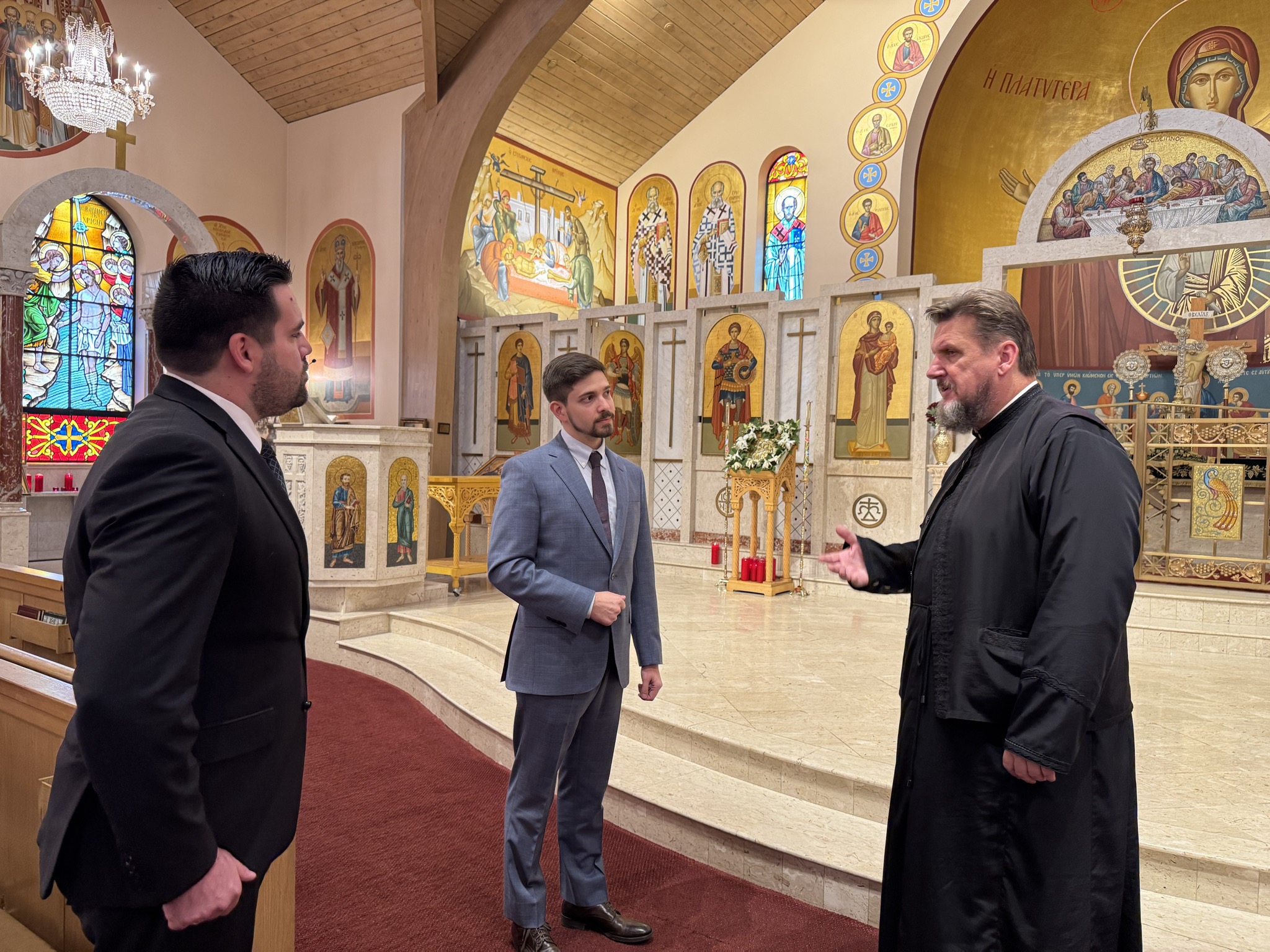
Historic Covenant Sealed with the Holy Orthodox Order of Saint George
The Royal and Princely House of Zaccaria de Damalà and the Holy Orthodox Order of Saint George the Great Martyr formally entered into a solemn alliance of perpetual amity and sacred cooperation, uniting their missions to mutually support humanitarian relief across the Christian East.
Read More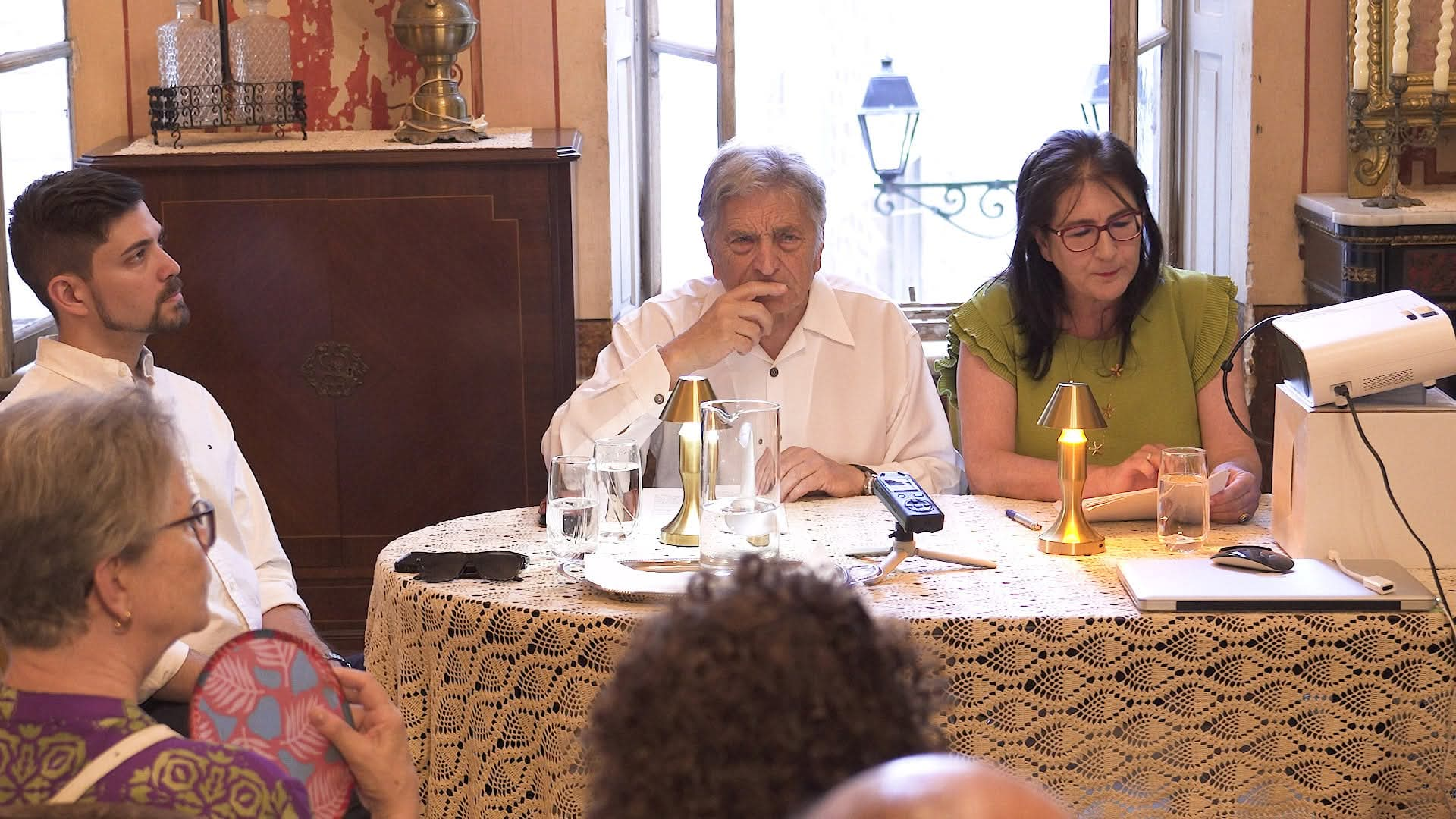
Historical Presentation at the Damalas Mansion
Prince Constantine attended a special historical presentation at the historic family residence in Ermoupoli as the guest of honour, featuring rich archival history and the presentation of a historic family portrait.
Read More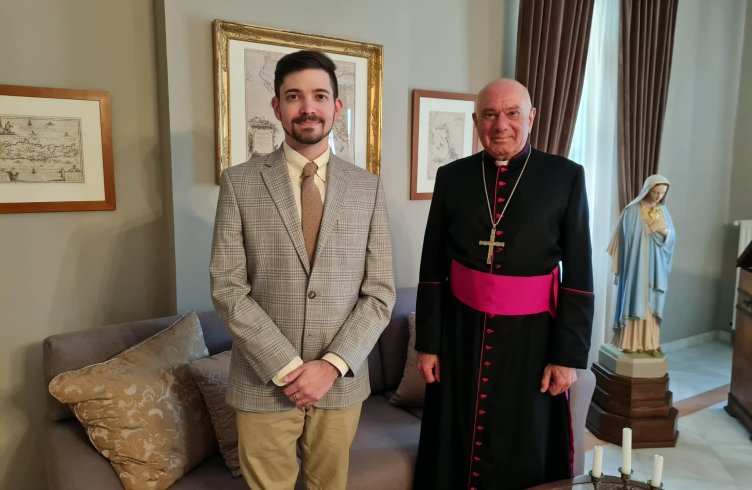
Audience at the Catholic Bishopric of Syros
Prince Constantine was received by Archbishop Sevastianos Rossolatos to honour the profound Latin-Genoese heritage of the House and its historical martial and spiritual alliances with the Holy See.
Read More
Audience with His Eminence Metropolitan Dorotheos II of Syros
The Prince was received in a formal private audience at the Metropolitan Palace, underscoring the deep ecclesiastical ties and legacy of spiritual stewardship linking the dynasty to the Greek Orthodox Church.
Read More
Bicentennial Celebrations of the Naming of Ermoupoli
At the formal invitation of the Municipality, Prince Constantine attended the grand civic celebrations marking 200 years of the city of Ermoupoli, featuring a spectacular tribute to the legacy of Mayor Ambrosios Damalas.
Read More
Historic Visit to the Ereto Rowing Club
The Prince was formally received by the President and Board of Directors at the historic offices of the Omilos Ereton in Piraeus, renewing the dynasty's historical ties with the institution and initiating plans for formal patronage.
Read More
Baptism of The Hereditary Prince
The Hereditary Prince Martino was baptised at the 11th-century Nea Moni monastery on the island of Chios. The historic sacrament bridges the dynasty's modern diaspora with its ancient sovereign roots in the Aegean.
Read More
Official Reception at the Municipality of Syros-Ermoupoli
The Prince was formally received by the Mayor of Syros-Ermoupoli at the City Hall to mark the bicentenary of the city and renew the dynasty's historical and philanthropic ties to the island.
Read Full Statement
Promulgation of the House Laws
The Prince has promulgated the new Private House Laws, codifying the succession and governance of the autonomous family community on the 700th anniversary of the 1325 grant.
Read More
700th Anniversary Reflection & Birth of the Heir
On the 700th anniversary of the imperial grant of the Kingdom of Asia Minor, the Head of the House reflects on the dynastic legacy of King Martino Zaccaria and announces the upcoming birth of his son and heir, Prince Martino.
Read Full StatementArchival studies, historical monographs, and cultural commentary authored by the Head of the House, examining the medieval and modern heritage of the dynasty across Chios, the Morea, and the wider Mediterranean.

A Mediterranean Caught Between Eras: The 1550s Aegean Portolan Chart
This 1550s portolan chart of the Aegean Sea captures a Mediterranean caught between eras. Drawn with a network of intersecting rhumb lines, it was a practical tool meant to guide sailors along the coasts of mainland Greece, Anatolia, and Crete. Yet its political landscape lags behind reality. The islands of Chios and Rhodes are clearly stamped with the crosses of the Genoese and the Knights Hospitaller. While the Genoese banner over Chios remained historically accurate for the 1550s, the Ottoman Empire had already expelled the Knights of Saint John from Rhodes decades earlier.
This specific chart is precisely the kind of working template that later cartographers traced to produce their own work. In 1662, the French mapmaker François Ollive created a nearly identical edition. Mapmakers routinely copied older sea charts to maintain accurate coastlines, carrying dead borders into new centuries out of sheer habit. Yet keeping those Christian flags intact was also a calculated commercial choice: wealthy European buyers preferred decorative maps showing a Mediterranean where Western powers still held their ground, ignoring the shifting empires of the actual era.

The Apollon Theatre of Ermoupoli & the Portrait of Sarah Bernhardt
My time at the historic Apollon Theatre this past April, the first of two trips to Ermoupoli this year, remains a distinct privilege. This architectural jewel of Syros beautifully embodies the cultural zenith of nineteenth-century Greece.
Standing before the portrait of our family's own, the incomparable Sarah Bernhardt, was a wonderful reminder of our family's enduring connection to the high arts and the grand traditions of European theatre. Erected in 1864 under the leadership of my great-granduncle, Ambrosios, and rightfully known as the "Piccola Scala," this magnificent venue has long acted as a sanctuary for history's most extraordinary artistic figures.
Preserving the memory of these cultural temples, along with the rare artefacts that grace them—such as the authentic antique sedan chair beside her portrait—stands as a solemn duty to our shared historical identity.

Marshalling the Imperial & Feudal Inheritance: The Great Quartered Arms
A most wonderful rendition of the Great Quartered Arms of our House, as beautifully captured by the master heraldist, D. Carlos Navarro. These arms marshal the full heraldic rights of our line. The Eastern Roman Imperial Eagle and the Palaiologos quarters themselves are borne jure sanguinis from the 1275 marriage of Benedetto I to the sister of Emperor Michael VIII Palaiologos, confirmed by the imperially recognised adoption of the double-barrelled surname "Palaiologo-Zaccaria" by his son, Benedetto II.
To visually assert this enduring imperial legitimacy—reflecting a history of intermarriage with the Palaiologoi that spanned from their first reigning generation to their very last—the imperial arms and double-headed eagle were proudly marshalled through the centuries. This deep dynastic bond culminated in the 1450s with their outright use as a primary emblem by our last reigning prince, John Asen Zaccaria (Centurione III). By that time, Prince John was not only a cousin to the imperial family, but a brother-in-law twice over to Emperor Constantine XI and his brother, Despot Thomas Palaiologos.
The Ducal de la Roche quarterings are borne jure matris through the marriage of Martino Zaccaria to the heiress Jacqueline de la Roche, Baroness of Damalà.
The Imperial Asen quartering is marshalled by right of descent from the successive marriages of Centurione I and Centurione II to Asenina-Palaiologina princesses. This inheritance was established by the formal and recognised adoption of the Asen surname by three consecutive generations: Grand Constable Andronikos Asen-Zaccaria, Prince Centurione II Asen-Zaccaria, and Prince John Asen-Zaccaria.
Bound together by the central Zaccaria-Damalà inescutcheon, the achievement rests upon the eagle and grand mantle, denoted by specific crowns of rank. The shield is ensigned by a Princely Crown representing the title of Prince of Achaea. The eagle and mantle are then surmounted by the Royal and Despotic Crowns, signifying the sovereign dignity of the King and Despot of Asia Minor. Altogether, the achievement stands as a vivid, visible testament to our House's enduring heraldic heritage.

The de la Roche Inheritance & the "+CASTE DAMALA" Coinage
Before the name Damalà became the enduring identifier of our House, its origins were forged in the crucible of fourteenth-century mainland Greece, shifting a dynasty's destiny far beyond the Aegean Sea. The catalyst for this transformation occurred in 1311, following the death of Renaud de la Roche at the Battle of Halmyros. In the chaotic aftermath of this defeat, the second Genoese Lord of Chios, Benedetto II Palaiologo-Zaccaria, became the suzerain of the Barony of Damalà, acting as the guardian of Renaud's underage heiress, Jacqueline de la Roche.
This temporary arrangement was permanently solidified into a hereditary possession in the early 1320s when Benedetto's son, Martino, married Jacqueline. She was no ordinary bride, as by this point, she was the last scion of the founding and longest-reigning dynasty of the Duchy of Athens. By securing her hand, Martino merged the prestigious Burgundian House of Athens with the maritime might of the Zaccaria.
The dynastic attachment to this new mainland title was immediate and thorough. Martino went so far as to mint a specific issue of denier tournois (tornese) coins bearing the legend "+CASTE DAMALA" (Castrum Damala). Dated between 1325 and 1329 and kept entirely separate from his Chian currency, this coinage represented a bold assertion of sovereignty within the Principality of Achaea. It marks one of only two known instances where a feudal barony exercised the princely right to mint coinage—the other being the Barony of Karytaina under Helena Angelina Komnene. Ultimately, these coins stand as the first physical evidence of the family fusing their Aegean sovereignty with their mainland ambitions.
This union proved to be a masterstroke of political calculation that ensured the lineage's survival. When the Zaccarias were later expelled from their wealthy lordship of Chios by their Byzantine cousins, it was this very barony that provided their crucial foothold in the Morea. It fell to Martino's son, Centurione I, to transform this rugged terrain into the family's new centre of gravity, governing his consolidated baronies with the absolute authority of a sovereign prince. Ultimately, this domain bestowed the surname that would carry their legacy out of the medieval world and into the modern era—a legacy that is preserved even now, as the House continues to bear and maintain the ancient de la Roche heraldic rights to this day.

The Myth of "Hassan of Samos": Identifying Prince John Asen Zaccaria in Pinturicchio’s Ancona Fresco
Though often known for its depiction of my great-granduncle, Thomas Palaiologos, in his blue hat, this famous fresco in the Piccolomini Library of the Siena Cathedral also contains someone routinely misidentified, yet unmistakable to those familiar with the relevant history. Pinturicchio’s magnificent work, Pius II Arrives in Ancona, captures the Pope’s final attempt to rally Christendom for a crusade. Within this grand composition, a prominent figure cloaked in green and wearing a white turban kneels respectfully in the right foreground alongside the Doge of Venice.
For well over a century, art historians and cathedral guidebooks have confidently labelled this man as "Hassan Zaccaria, deposed Prince of Samos." Though it is exceedingly clear upon examination, this identification is a staggering historical and linguistic error.
The glaring misnomer of "Hassan" originates not from fifteenth-century records, but from nineteenth-century art cataloguers trying to make sense of the fresco. Early scholars codified the "traditional" identities we see in textbooks today. When encountering archival references to a displaced noble named "Asano" or "Asan" Zaccaria at the papal court, these historians looked at Pinturicchio's painting. Seeing a figure dressed in an exotic white turban kneeling right next to an actual Ottoman hostage (il Turchetto), they carelessly assumed "Asano" was simply a phonetic Italian misspelling of the Islamic name "Hassan." To complete the picture, they appended the anachronistic title "Prince of Samos," pulling a recognisable Aegean domain from the Zaccaria family’s past.
The error was fatally compounded by the nineteenth-century historian Carl Hopf, who fabricated the claim that our ancestor was an illegitimate son. Because academia accepted this myth, they dismissed his right to carry the jealously guarded dynastic surname of his mother, an imperial Asenina Palaiologina princess, making the jump to "Hassan" seem plausible. In reality, this figure is none other than my fourteenth great-grandfather, John Asen Zaccaria, the legitimate son and heir of Prince Centurione II of Achaea. His true geopolitical weight was not in Samos, but the Peloponnese. There, utilising the momentum of the 1453 Morean Revolt, he briefly revived the principality and was formally recognised as a sovereign peer under the regnal name Prince "Centurione III" by the Venetian Republic, the Kingdom of Naples, and the Holy See. This diplomatic recognition remained widespread throughout his subsequent exile (1455–1469), during which he was continuously acknowledged as Prince of Achaea by the majority of Italian states and granted a papal pension as such.
Pinturicchio’s visual evidence perfectly corroborates this reality. The kneeling figure possesses the pale complexion, sharp features, and reddish-brown beard of a Southern European nobleman, reflecting his Genoese and Byzantine heritage. This becomes undeniably clear when contrasted with the standing figure immediately behind him—the historical Ottoman prince il Turchetto. Pinturicchio painted him with a distinct olive complexion, an aquiline nose, and a drooping dark moustache. The contrast is stark: il Turchetto is an authentically rendered Ottoman, whilst the kneeling figure is undeniably a Greco-Italian prince merely draped in the generic "Eastern" visual shorthand of a Renaissance turban. Furthermore, his placement kneeling directly beside Doge Cristoforo Moro cements his documented historical alliance with Venice, who funded and utilised him as a strategic ally following his 1453 revival.
The definitive proof, however, is found in the historical record of the Ancona crusade itself. In 1464, Pope Pius II gathered volunteer crusaders and soldiers, deciding to lead the expedition to Ancona in person. Historical accounts confirm that when the Pope left for Ancona, he travelled alongside specific exiled figures, intending to restore them to power as Latinophile leaders in the East. Among those travelling directly with Pius II were Thomas Palaiologos (the heir to the Byzantine throne), the Ottoman hostage prince, and notably, Thomas's former rival and brother-in-law, Giovanni Assan Zaccaria (John Asen Zaccaria), the last Prince of Achaea.
As a highly visible, dispossessed Christian prince who physically travelled with the Pope to the very event depicted in the fresco, he was precisely one of the figures Pinturicchio would memorialise. Once the nineteenth-century cataloguing errors are recognised, the supposed mismatch of a Muslim prince in a Catholic crusader fresco vanishes. The turbaned man is undeniably our ancestor, John Asen Zaccaria, Prince of Achaea, rightfully taking his place in the historical fabric of the Renaissance.

The Great Benefactor of Chios: Ioannis Damalas (1845–1916)
Having reflected on the vibrant lives of his younger brothers, I turn now to the nineteenth Head of our line: Ioannis Damalas. Whilst my previous notes explored the significant sporting and civic contributions of Pavlos, alongside the cultural notoriety of Aristides, Ioannis pursued a quieter, though no less consequential, path. Born in Ermoupoli in 1845, Ioannis was the eldest son of Ambrosios Damalas and Calliopi Ralli.
Raised amidst the immense prominence his father had reclaimed in the decades following the 1822 Chios Massacre, he expanded the financial footprint of his generation by maintaining extensive interests in Marseille. Much like his father, he adhered strictly to the endogamous traditions of the Libro d’Oro families, marrying Catherine Ralli in a union that further solidified the tight-knit bonds of the Chiot nobility in exile.
The foundation for our House's formal return to the island had been set in motion in 1859, when thirteen of the original thirty-seven noble families formally reconstituted Chios’ historic assembly, the Cantouni. With our lineage formally represented at the time by his first cousin, this restoration paved the way for Ioannis to eventually return to our ancestral island and continue our tradition of statecraft.
He assumed the office of Mayor of Chios, serving from 1878 to 1882, a tenure that placed him at the helm during the catastrophic 1881 earthquake. In the chaotic aftermath of a disaster that levelled the region, the Ottoman governor mandated the creation of a centralised relief committee. Appointed as its President, Ioannis shouldered an immense logistical burden. He coordinated incoming European funds, established soup kitchens, and managed the distribution of aid to an estimated 27,000 newly homeless citizens. Yet his dedication to the island's revival was not merely administrative; remembered historically as a "Great Benefactor" of Chios, he ultimately donated his entire personal fortune to the School of Chios.
Ioannis anchored our senior line steadily through this gruelling period of regional recovery, though his later years were marred by profound personal sorrow. In 1913—the very same year Chios finally united with the rest of Greece—his only son, named Ambrosios after his grandfather, tragically passed away. Coupled with the death of Pavlos’s only son that exact same year, the loss of both heirs was a devastating blow to the family.
When Ioannis died just three years later in 1916, the headship passed to Pavlos. Ioannis may not have left behind the international prestige or the cultural mythos of his siblings, but he bequeathed something equally enduring: a legacy of steadfast stewardship and supreme generosity during his community’s darkest hour.

29 May 1453: The Fall of Constantinople & Our Familial Obligation
Following my reflection last week on the restoration of Mystras, we recently observed a heavy anniversary: 29 May 1453, the fall of Constantinople. The words "The City has fallen" marked the end of an empire and the dissolution of an entire world. Constantine XI Palaiologos, the last Roman Emperor, fought to the very end despite the odds, embodying the enduring Roman spirit. He fell alongside his city, refusing to abandon the capital that had stood as the beating heart of civilisation for over a millennium.
When a dynasty fades, its legacy rightfully belongs to the collective memory of the people and culture it shaped. The immortal idea of the Palaiologoi belongs to all of us, as the inheritors of Western civilisation. Yet, for a surviving lineage that was so deeply intertwined with them, there is a deeply personal duty to actively advocate for these ancestors. Between the thirteenth and fifteenth centuries, our Houses were united through several imperial marriages that kept our ties with this illustrious family alive, from its first reigning generation to its very last. The imperial double-headed eagle of the dynasty, and the Palaiologos name itself, became inextricably woven into our own identity. This enduring union is forever preserved in the very motto of our House: Christos Sotir ton Palaiologon-Zaccaria de Damalà ("Christ, Saviour of the Palaiologos-Zaccaria de Damalà"). Because of this, commemorating the last Emperor is not merely an observation of history, but a familial obligation.
Today, the physical empire is gone, but the legacy of Byzantium was not extinguished in the ruins of 1453. It survives through the Church, which has carefully preserved many of its customs through the darkest centuries, and in the living memory of the generations that follow the path that Christ has laid for us. Upholding the entirety of our Roman heritage together is precisely how that legacy remains alive: we remember, because history is not merely written, it is inherited.

The Restoration of the Palace of the Despots at Mystras
The Ministry of Culture’s recent inauguration of the restored Palace of the Despots at Mystras is a masterful triumph of historical preservation. For centuries, Mystras stood as the formidable heart of the Byzantine Morea, a bastion of the Palaiologos dynasty during the twilight of the Empire. To see life and reverence breathed back into these ancient stones is a profound achievement for Hellenic heritage, and one that carries a deeply poetic historical resonance.
There is a unique irony in the passage of time. The Despots of the Morea were the fiercest historical rivals to the Latin Princes of Achaea, yet the two Houses were inextricably bound together as cousins and in-laws, locked in a bitter, intertwined struggle for the Peloponnese. Today, whilst the Palaiologos dynasty has long passed into the quiet halls of memory, our line endures. Over the centuries, the ancient animosities of the era have faded, leaving only the profound weight of a shared, synthesised heritage.
Perhaps the ultimate irony is that the descendant of their greatest rival now looks upon the restoration of their capital not with the enmity of the past, but as a fervent champion of its preservation. We do not merely guard our own perspective of history, but the entirety of the complex tapestry that forged us. The Ministry's dedication to resurrecting these timeless centres of culture offers immense hope that other long-obscured chapters of our shared medieval past will similarly be brought into the light.

Preserving the Authentic History of the Church of the Holy Apostles in Pyrgi
It is a profound irony that whilst the magnificent dome of the Church of the Holy Apostles in Pyrgi commands immediate admiration, the history of its foundation is currently obscured from public view. Originally established as a private funerary shrine by our family during the early fourteenth century, the church served as the very nucleus around which one of Chios's most recognisable villages developed.
Following its destruction by an earthquake in 1546, the structure was raised from its foundations and reconstructed in 1564 by the monk Symeon Damalà, later Metropolitan of Chios. Whilst the upper vaults beautifully display this centuries-old artistry, a crucial piece of the monument's narrative languishes out of sight at ground level.
It is deeply unfortunate that the specific fresco depicting the church's founders remains completely hidden behind the traditional wooden stasidia seating that lines the walls. Because of this obstruction, I was unable to show my son his own family name, which has been boldly inscribed there in medieval Greek for centuries. This physical obscuring is compounded by a disappointing historical omission, as both the official plaque outside the church and the modern digital summary fail to list the founders whatsoever. Preserving a building whilst ignoring the lineage that built and sustained it is a disservice to the authentic history of Chios.

Guarded Across the Centuries: A Byzantine Gold Pectoral Cross
Whilst examining older family heirlooms, my thoughts returned to this gold pectoral cross, a deeply personal artefact that has endured since the days of Byzantium. Standing just over two inches tall, the piece is a striking expression of Byzantine craftsmanship. Its lobate terminals are deeply stamped with concentric circles and inner crosses, radiating outward from a raised central quatrefoil.
What makes this cross truly extraordinary is its uncompromising state of preservation. Hollow gold from antiquity is notoriously fragile, almost universally found crushed, torn, or severely deformed by the weight of the earth over the centuries. The fact that this piece survives with its crisp detailing, symmetrical form, and original fluted bail completely intact speaks to a different kind of journey. It was never lost to the soil; rather, it was guarded and passed down, surviving the centuries well out of the elements.
Though its pristine condition might suggest a relic kept strictly under glass, its history with me has been far more tactile. For a time, it was a daily fixture around my neck. During that period, it even accompanied me swimming in the Aegean—a fitting immersion, perhaps, for an artefact so deeply tied to those waters and the history of the ancestors who navigated them. Today, it is retired from everyday wear and rests carefully preserved alongside other familial pieces, a tangible and enduring link to a storied past waiting patiently for the generations to come.

Louca Damalà, Voivode of Mykonos, & the Legal Revolution of 1682
Long after the Frankish principalities of the Aegean had dissolved into history, the dynastic memory of the House of Zaccaria de Damalà found a formidable, if turbulent, vessel in the figure of Louca Damalà. A direct descendant of the Genoese lords who had once minted their own coinage as Lords of Chios and reigned as sovereign Princes of Achaea, Louca did not view himself merely as a functionary of the Ottoman era.
Hailing from the Nobility of Chios—a caste accustomed to a level of autonomy unknown to the rest of the Aegean—he arrived on Mykonos in 1679 with the haughty bearing of his "Most Honourable and Noble" House. He came not merely to administer, but to reclaim the authority of a fiefdom. Appointed as Voivode and Epitropos, the iron hand of his cousin, the Great Dragoman Alexandros Mavrocordatos, Louca governed with a sovereignty that belied his official status. In a striking display of baronial power, he dismissed the rustic, customary laws that had long governed the Cyclades. Instead, operating as the Exousiastes (Sole Ruler), he unilaterally introduced formal Byzantine legal codes to the island’s courts.
His legal revolution of 1682 stands as a singular anomaly in the archives. For nearly five centuries, since the Frankish conquest of 1207, Mykonos had been "alien" to Imperial law, drifting instead into the orbit of the Principality of Achaea and the feudal Assizes of Romania. It took Louca Damalà to break this precedent. Unlike the senior line of his House, which remained staunchly Catholic and Genoese, Louca belonged to a branch of early converts who had returned to the Orthodox fold—kinsmen of Symeon Damalà, the Metropolitan of Chios who renovated the Church of the Holy Apostles. Thus, in a definitive rejection of his Frankish origins in favour of his Imperial Palaiologan blood, he swept aside the feudal customs of the populace to resurrect the high laws of Constantinople.
His rule was defined by a ruthlessness that historical accounts record as oppression, but which Louca likely viewed as the necessary prerogative of his station. When the populace failed to meet the demands of the poll tax, he exercised a feudal severity that bordered on the tyrannical. Records recount that "Mise Loukis" seized the very garments of the peasantry—a harsh enforcement of fiscal discipline that treated the islanders not as fellow subjects, but as serfs on a medieval estate.
This was not merely corruption; it was a clash of eras. Louca was ruling with the "Right of the Sword" in a diplomatic age. His "innovations" and "grievous troubles" eventually forced the Community of Mykonos to bypass him entirely, sending desperate envoys to Constantinople with the plea: "Lord, save us from the men you sent."
Though his recall in 1683 marked the limits of his ambition, his story did not end with a simple dismissal. He died on the island in 1688, a Governor who had tried to resurrect the sovereignty of his ancestors in a world that had no room for a new Prince. His demise left an estate so chaotic and significant that it required the personal intervention of his brother, Neophytos, the Metropolitan of Thessaloniki. That his closest kin was not a Latin prelate, but a high-ranking hierarch of the Orthodox Church, serves as the final testament to Louca’s identity: a Zaccaria who had fully embraced the Imperial legacy of the East, whose hubris was matched only by the weight of his name.

From Constantinople to the Court of Athens: Iakovos Zanni Damalà (1899)
Captured in the fading light of the nineteenth century, this 1899 photograph features Iakovos Zanni Damalà, my grandfather’s second cousin, alongside our Petrocochino cousins. As a scion of one of the thirteen families that formally reconstituted the Chiot nobility in 1859, Iakovos did not merely inherit a legacy; he expanded it across the empire.
Whilst his father, Ioannis (Jean), established their branch as "Gentlemen" of Constantinople and stakeholders in the Commercial Bank of Alexandria—as recorded in the London Gazette of 1877—Iakovos looked further East. He became the Director of Operations of Ralli Brothers in India, exemplifying the global reach of these Chiot dynasties.
Yet the pull of Athens remained: he married Hélène Lüders, eldest daughter of Otto Lüders, the Lord Chamberlain to King George I and tutor to the future King Constantine I—a remarkable convergence of the Chiot patriciate and the Royal Court.

Centurione I Zaccaria de Damalà: Grand Constable, Bailli & Kingmaker of Achaea
Long before the Principality of Achaea faded into the twilight of the late medieval world, its survival was largely sustained by the sheer force of will of figures like Centurione I Zaccaria de Damalà. He was the son of the renowned Martino Zaccaria and Jacqueline de la Roche, the last scion of the founding dynasty of the Duchy of Athens.
His father's union brought the Barony of Damalà, which began the family's initial foothold in mainland power, minting coinage for the barony even whilst reigning as Lord of Chios. However, it was Centurione who transformed this foothold into the family’s new centre of gravity. In 1334, he received the barony upon the death of his elder brother Bartolomeo, Marquis of Bodonitsa, whom their father had originally entrusted with the Achaean domain. Yet, for over a decade, Centurione’s gaze remained fixed on the Aegean. Following the family's initial expulsion from Chios by the Byzantines in 1329, he doggedly maintained their presence in the archipelago, eventually returning to the island as Protokomes to administer its defence on behalf of the Empire. It was only the Genoese conquest of 1346 that marked the definitive end of this maritime chapter; forced to depart the ancestral seat, he turned his ambition permanently to the mainland. It was here that he solidified Damalà not merely as a possession, but as what would become the enduring identifier of our House.
Operating with the demeanour of a sovereign prince rather than a vassal, he consolidated the baronies of Damalà, Chalandritsa, and Estamira into a formidable power base. His indispensable nature was such that, despite his defiance, he served thrice as Bailli (Viceroy) of the Principality, effectively ruling the Morea on behalf of successive Angevin princes who never once set foot in their Achaean domain. His authority was so absolute that when the envoy Nicholas of Boyano arrived in 1360 to collect feudal dues for Empress Marie of Bourbon, he found himself powerless against Centurione’s "bland words" and refusal to pay. In his report, the exasperated envoy described Centurione as an insolent "tyrant" who governed with the swagger of "Prince William of Villehardouin himself come back to life," and starkly warned the Empress that Zaccaria must be subdued if she and her son wished to hold real authority in Romania.
This defiance was not reckless; it was calculated. When the princely succession was later disputed, Centurione, by then appointed as Grand Constable of Achaea, travelled to Naples as a kingmaker. In a striking display of baronial power, he rendered Queen Joanna I homage only "after she had sworn to respect the usages and customs of the Principality."
Yet his vision extended far past the feudal boundaries of the Latin states. He maintained a privileged standing within the Byzantine imperial court, a status confirmed in 1352 when he signed a treaty with Emperor John VI Kantakouzenos in Galata as "the first among all the Latins." By holding the high Byzantine dignity of Protokomes whilst commanding Papal forces during the Smyrniote crusades, he acted as a rare bridge between the fading Frankish West and the enduring Roman East.
Crucially, he secured the future of the lineage by weaving it once again into the imperial tapestry of Constantinople. He married the daughter of Andronikos Asen, the Epitropos of Morea and a grandson of Emperor Michael VIII Palaiologos. This union marked the second infusion of imperial blood into the line, celebrated in the Orthodox rite—a tradition the family would faithfully observe until the time of his great-grandson, John Asen Zaccaria, who would briefly revive the principality after the fall of Constantinople. It was in Centurione I, however, that the maritime heritage of Chios found its firmest footing on the mainland, laying the necessary groundwork for his grandson and namesake, Centurione II, to eventually secure the Principality of Achaea itself as a sovereign polity for the family.

The Palacio de los Marqueses de la Mesa de Asta: Seat of the Zacarías de Jerez
The Spanish branch of the family, established by Benedetto I’s second son Martín, left a tangible architectural footprint in the heart of Jerez de la Frontera, Spain, at their ancestral seat, the Palacio de los Marqueses de la Mesa de Asta. Known today as the "Palacio Pemartín" in the Plaza de San Juan, this edifice served as the residential seat of the Villavicencio y Zacarías lineage for centuries.
Its foundations tell an even older story of their maternal ancestry. The entrance hall still boasts a magnificent fifteenth-century Mudéjar alfarje (wooden ceiling), upon which the painted coats of arms of the López de Hinojosa family remain visible. This heraldry is a direct physical link to Doña Inés Gil de Finojosa, the wife of the Spanish progenitor Don Martín Giraldo Zacarías, indicating that this property likely entered the fold through that marriage before becoming the definitive seat of the Zacarías-Villavicencio descendants.
Following the pivotal marriage of Don Martín’s granddaughter, Doña Juana Fernández de Zacarías, to Don Lorenzo Fernández de Villavicencio, this palace became the centre of the family's influence in Andalusia. Just as the Zacarías wealth had saved the Villavicencio line from financial ruin, it was the family's continued prosperity that transformed this medieval structure into a Baroque masterpiece. The grand façade and courtyard seen today were the result of a massive renovation commissioned in the 1770s by the Marquesa de la Mesa de Asta, the last matriarch of the Villavicencio y Zacarías line. It stands as a testament to the "Zacarías de Jerez," a branch that, though it eventually passed its titles through female lines, ensured its house remained one of the most powerful in the region.
Today, the palace houses the Centro Andaluz de Flamenco, serving as a guardian of Andalusian culture much like the family once guarded the Alcázar. Whilst the signage outside may bear a different name, the stones and the heraldry within continue to testify to its true origins—where the standard arms of the House were maintained on the Iberian Peninsula long after the male line of Benedetto's Castilian marriage had faded into history.

The Five Gates Castle (Beşkapılar) of Old Phocaea
The Five Gates Castle, or Beşkapılar, situated in the harbour of Old Phocaea, represents a continuous line of maritime defence that began well before its current name was established. Whilst the site had been inhabited since antiquity, the medieval fortress was effectively born from the Treaty of Nymphaeum, when Emperor Michael VIII Palaiologos granted the lordship of the area to the Genoese noble Manuele Zaccaria in 1267.
The Zaccaria rapidly fortified the settlement, not merely for territorial control, but to secure the invaluable alum mines nearby. Under Manuele and his brother Benedetto I Zaccaria, the castle served as the nerve centre for a massive industrial monopoly, defended by a private fleet that protected the extraction and shipment of alum to the textile markets of Bruges and Florence. This period marked the castle's peak as a semi-autonomous Latin colony, operating independently of the Byzantine capital until the resurgence of imperial power under Andronikos III in 1340 reasserted Roman control.
Control of the fortress remained fluid throughout the tumultuous fourteenth and fifteenth centuries, reflecting the waning power of Byzantium and the rising influence of local dynasts. Following the brief Byzantine restoration, the castle eventually passed into the hands of the Gattilusio family, the Genoese lords of Lesbos, who maintained the fortifications as a mainland outpost for their island principality. This era of Genoese custody ended in 1455, when the fortress was surrendered to the Ottoman Sultan Mehmed II. Rather than dismantling the site, the Ottomans integrated it into their coastal defence network. The specific architectural form seen today, particularly the five distinct arched bays that served as a fortified boat shelter, was largely formalised during the renovations of 1538 by Silahtar Iskender Ağa, undertaken to counter the growing naval threat of the Knights of St. John and the Holy League.
The fortress continued to see active defensive service well into the early modern period, serving as a garrison against Venetian incursions during the long struggles for the Aegean. Its walls withstood their most significant later test during the Cretan War in 1649, when Venetian fleets blockaded and bombarded the harbour in an attempt to cut Ottoman supply lines, and saw action again during the Orlov Revolt of 1770. Today, placed on the UNESCO World Heritage Tentative List as part of the historic fortifications on Genoese trade routes from the Mediterranean to the Black Sea, the extant structure stands as a physical timeline bearing the masonry of Genoese lords, Byzantine emperors, and Ottoman commanders in a single contiguous fortification.

On the Nicaea Declaration Between Ecumenical Patriarch Bartholomew & Pope Leo XIV
I greet with profound emotion the historic embrace between His All-Holiness Ecumenical Patriarch Bartholomew and His Holiness Pope Leo XIV. This declaration at Nicaea breathes new life into a hope long cherished by all who seek concord between the Apostolic Thrones. My House bears witness to the unique convergence of these two traditions.
The Zaccaria Princes of Achaea once governed a Latin realm within the Greek world; yet, over the centuries, our lineage became irrevocably rooted in the spiritual inheritance of the East. This dual legacy stands as a living testament that the memories of West and East need not be opposed. They can coexist within one family and one faith.
The reconciliation expressed at Nicaea strikes a deep resonance within our history. It recalls the arduous efforts of ages past—burdens once borne by my august kinsman, the Emperor Constantine XI Palaiologos, who sought unity with sincerity in the shadow of the gathering storm. The cultural tapestry of the Morea and the Aegean was woven from that very search for concord. This vocation endured into the modern era through Nikolaos Damalà, who represented the Church in the pivotal nineteenth-century dialogues on Union, bearing witness that true concord requires both theological rigour and the integrity of conscience.
The House of Zaccaria de Damalà therefore pledges its full support to those initiatives that strengthen mutual respect between the Catholic and Orthodox Churches. We affirm that reconciliation is not a distant ideal, but a path paved by humility and the healing of memory. May the work begun at Nicaea advance with prudence and grace.

Professor Nikolaos Damalà (1842–1892): Mentor to St. Nektarios & Royal Commissioner
Before St. Nektarios of Aegina became one of the most beloved saints of the Orthodox Church, he spent his first years in Athens studying under my second great-granduncle, Nikolaos Damalà (1842–1892). Those who knew him at the time wrote that the young Nektarios flourished under Nikolaos’s guidance and protection, finding in him both a mentor and one of the most rigorous theological minds of that era.
Born in Athens to an old Chiot family, Nikolaos studied theology at the University of Athens before completing advanced studies in Erlangen, Leipzig, and London, where he earned his doctorate in 1863. He returned to Greece to teach New Testament Introduction and Exegesis at the National and Kapodistrian University of Athens from 1867 until his death, serving four terms as Dean of the Faculty of Theology and as Rector of the University from 1878 to 1879.
A prolific and foundational scholar, he authored major works that remain authoritative to this day, including On First Principles («Περί Αρχών»), Introduction to the New Testament («Επαγωγή εις την Καινήν Διαθήκην»), Interpretation of the First Three Gospels («Ερμηνεία των τριών πρώτων Ευαγγελίων»), and Orthodox Christian Catechism («Ορθόδοξος Χριστιανική Κατήχησις»), as well as studies on Pauline theology and the history of dogma. He edited the final volumes of Adamantios Korais’s writings, represented Greece and the Church at international theological conferences, and took part in the significant nineteenth-century dialogues surrounding Church Union with both the Old Catholic and Anglican Churches.
What ultimately defined Nikolaos, however, was the integrity of his conscience. In 1876, whilst serving as Royal Commissioner to the Holy Synod, he refused to sign the synodal decision confirming compromised bishops during the Simoniacal bribery scandal. It was a quiet but unmistakable act that affirmed the moral independence expected of those who serve both Church and nation. Alongside his close relatives who served in civic leadership, Nikolaos represents the intellectual and spiritual thread of our House—a legacy of faith, learning, and public duty held together as a single vocation.

11 November 1912: The Liberation of Chios
On 11 November 1912, our beloved island of Chios was liberated from Ottoman rule during the First Balkan War. The Greek Navy, under the command of Rear Admiral Pavlos Kountouriotis, orchestrated a strategic assault on the island, which had been under Ottoman control since 1566, marking the end of nearly 350 years of Ottoman domination.
The Greek forces—comprising three cruisers, two destroyers, and three troopships carrying 2,500 soldiers—landed on Chios and swiftly took control of the town. Despite the well-prepared Ottoman garrison, the Greek troops managed to secure the island after weeks of intense battles, making this victory a significant milestone in the Greek struggle for independence.
The liberation of the island symbolised the end of a long history of foreign rule. Through an agreement with Roman Emperor Michael VIII Palaiologos, our forebears established rule in the region from 1267 into the 1340s, with the Lordship of Chios at its core from 1304 to 1329, when it was briefly reclaimed by Constantinople. The island's history continued with the Genoese Maona of Chios and Phocaea, administered by the Giustiniani clan from 1346 to 1566, and the brief Venetian interlude during the Morean War (1694–1695) prior to Ottoman recapture.
The liberation of Chios in 1912 was officially recognised by the Treaty of London in 1913, which confirmed Greece's union with the island alongside other Aegean territories—an event celebrated annually on 11 November in tribute to the bravery of the Greek forces and the resilience of the island's inhabitants.

The Kastoria Icon of Saint George: A Liturgical Monument to the Zaccaria-Palaiologos Union
In the Byzantine town of Kastoria, a remarkable bilateral icon (107 × 72 cm) of Saint George was created around 1300. It is unlike most icons of the saint, for here he bears a triangular shield, quartered in two tinctures. At first glance today the shield seems to alternate red and black, but closer examination shows traces of gilding beneath the darkened surface. What once gleamed as gold has over time oxidised and faded, leaving a misleading impression.
The heraldic design that emerges—quarterly Or (gold) and Gules (red)—is precisely that of our arms, from the time we were entrusted with Phocaea and later Chios by the Palaiologos emperors. Benedetto I Zaccaria was celebrated as admiral of the Byzantine fleet under Emperor Michael VIII and served as his ambassador to the West in 1282, enabling the emperor to leverage Benedetto's Iberian connections to engineer the Sicilian Vespers. He later married into the Imperial House, leading us to append the Palaiologos name to our own during that period. This context is crucial, since at the feet of Saint George a kneeling female donor is shown—an aristocratic patron most naturally explained as a member of this same imperial family of Orthodox faith. The icon therefore stands as a commission that joins Latin heraldry with Byzantine devotion, at the very frontier where our lineage and Byzantium were bound together.
This interpretation was powerfully advanced by art historian Manuel A. Castiñeiras, who marshalled multiple lines of evidence: the historical setting of Zaccaria rule in Asia Minor; the dynastic Palaiologos alliance; the donor portrait; the shield itself; the parallel armorials preserved in Zaccaria coinage of Chios; and the banner of Phocaea on Angelino Dalorto’s 1325 portolan chart. All converged on a single conclusion: the Kastoria Saint George is the physical representation of the aforementioned dynastic union.
In a later publication, Castiñeiras pulled back from his own identification, suggesting instead that the shield might be a generic "Latin" emblem. That retraction was prompted not by new findings, but by a long-standing error: the belief that our arms were quartered red and silver. This error originates with Giovanni Battista di Crollalanza’s 1890 misreading of Dalorto’s chart, where the faded gold of several banners was mistaken for silver. The same problem occurs on the Kastoria icon: what was gold now looks black. Misled by the persistent 1890 error and the degraded state of the pigments, Castiñeiras thought the colours mismatched—assuming that in order to be Zaccaria, red needed to be in the first and fourth quarters—and abandoned his earlier conclusion.
Yet once the mistake is recognised, the logic of the original identification stands firm. The correct distribution is gold (1st & 4th) and red (2nd & 3rd), matching perfectly with the icon. Every witness agrees: our coinage, the portolan (read in proper orientation), and the traces of gilding still visible on the icon. With the colour corrected, the supposed "mismatch" vanishes, and the shield resumes its rightful place as Zaccaria heraldry.
The case is strengthened by a further curiosity: a French map of the mid-seventeenth century places the crowned, quartered gold-and-red arms directly over Kastoria, long after the Zaccaria name would have been displayed as rulers of Greek territory. The most plausible explanation is that the mapmaker reflected what he saw or was told of a famous object in Kastoria: the icon itself. Today preserved in the Byzantine and Christian Museum of Athens, the Kastoria Saint George stands as a liturgical witness to the alliance of Zaccaria and Palaiologos.

Two Genoese Admirals: The Intertwined Legacies of Benedetto I Zaccaria & Christopher Columbus
Over the years, I have increasingly noticed that Christopher Columbus and Benedetto I Zaccaria share an extraordinary number of historical parallels. Both men hailed from Genoa, the maritime republic that nurtured their seafaring ambitions, and both stand immortalised side by side on the façade of the Palazzo San Giorgio in Genoa.
The first of many notable connections between these two figures is their tie to the island of Chios. In 1304, Benedetto I Zaccaria was granted Chios and neighbouring islands by his imperial kinsmen, establishing Genoese control which would last until 1566. Similarly, Columbus maintained a documented connection to Chios, residing on the island during his early voyages in the Aegean, where he honed his navigational skills and understanding of Mediterranean trade routes prior to his Atlantic enterprise.
The connections of these two men to Spain further intertwine their legacies. In 1284, Zaccaria was granted the port of El Puerto de Santa María by King Sancho IV of Castile, creating it as a hereditary lordship with Benedetto as its first Lord. This is the very same port where Columbus prepared for his historic 1492 voyage to the New World, staying at the Castle of San Marcos under the protection of the Duke of Medinaceli.
Both men held prestigious naval titles granted by the Spanish Crown. Zaccaria held the Castilian title of "Admiral of the Sea" (Almirante Mayor de la Mar), commanding the entirety of the Castilian fleet through major campaigns, whilst Columbus would later be titled "Admiral of the Ocean Sea." Their coats of arms—Zacarías and Colón—appear together across the classic heraldic rolls of Spain, and their paired frescoes on the façade of the Palazzo San Giorgio in Genoa confirm that the Republic itself recognised their parallel achievements across the centuries.

At the Crossroads of Art & Empire: The Enigmatic Life of Tereza Damalà (1889–1967)
Among the more enigmatic figures of our family’s recent past is Tereza Damalà (1889–1967), a second cousin of my grandfather—a woman whose life may read like fiction, though it was entirely real. Her story became the subject of Tereza (1997), a historical biographical novel by the renowned journalist Freddy Germanos, who assembled eyewitness recollections from Mary Hemingway, Archibald MacLeish, Henry Villard, Melina Mercouri, and others.
Through their testimony, Germanos restored to view a woman known to them as "the Greek princess" who moved through the cultural and political salons of early twentieth-century Europe with an aura of mystery and magnetism. As the natural daughter of Jacques Damalà—the Greek aristocrat who rose to fame in Parisian society as the husband of Sarah Bernhardt—she was taken in as an infant upon his death by his close friend, Sir Basil Zaharoff. He arranged for the girl’s upbringing in Adrianople, in Eastern Thrace, where she was baptised Tereza and later adopted the Damalà name. Upon her marriage in 1916 to a senior member of the Greek royal court, she formally entered Athenian high society.
By the years of the Great War, Tereza was a familiar presence in the courtly entourage of King Constantine I during his exile; former Athens Mayor Spyros Mercouri recalled meeting her on Corsica where they were both exiled. In Italy she became known as "Tereza D’Annunzio," a reflection of her close association with the poet Gabriele D’Annunzio, Prince of Montenevoso. In his poem Canzone dei Dardanelli ("Song of the Dardanelles"), D’Annunzio had written admiringly of our forebear, Martino Zaccaria, Lord of Chios and Damalà, and King and Despot of Asia Minor:
"In royal power Asia Minor has Martino Zaccaria; he mints coins, raises armies and ships, works in Phocaea for alum, in Chios for silk […] fully armed as a King he dies in battle."
Through him and others, Tereza met many of the significant figures of her day—including Pablo Picasso, for whom she posed—yet it was Ernest Hemingway, then a young American correspondent, who carried her memory for life. Mary Hemingway later confirmed that her husband spoke often of "the Greek woman," and that letters referring to her remained among his papers. Preserved in private correspondence and the recollections of those she captivated, Tereza endures as a remarkable figure who lived at the crossroads of art and empire.

The Libro d’Oro of Chios & the 1859 Reconstitution of the Cantouni
For centuries, the high society of Chios was marked by a level of refinement and education that set it apart in the region, maintaining a corporate circle reserved exclusively for the nobility—something unique in the Eastern Mediterranean. At its height, only thirty-seven noble families presided over an island of roughly 120,000 inhabitants: barely one noble family per 3,200 people, compared to roughly one per 700 in Venice, one per 400 in Corfu, or one in 50 in France.
It is often said that this corporate patriciate ended abruptly with the horrific destruction of 1822, when the island’s society was shattered and its noble families massacred or dispersed. Yet the historical record of the Libro d’Oro of Chios demonstrates otherwise. In 1859, on the banks of the Kokalas river, members of those same families formally reconstituted the nobility, reviving it on precisely the same basis as before under its historic name: the Cantouni (Τὸ Καντούνι), denoting the corporate assembly of the island’s noble class.
Of the original thirty-seven noble houses, thirteen formally re-established the institution in 1859: Argenti, Calvocoresi, Chrysoveloni, Damalà, Mavrogordato, Negroponte, Paspati, Petrocochino, Ralli, Rodocanachi, Scanavi, Scaramanga, and Zygomala.
From that point, the nobility of the Mediterranean's tenth-largest island endured in this reconstituted form into the twentieth century. Its final dissolution was not abrupt in 1822, but gradual after 1913 following Chios's integration into the modern Greek state. To this day, these names remain familiar not only on Chios, but across Greece and Europe as influential dynasties of statecraft, shipping, and banking whose resilience carried them through centuries of upheaval.

"The Zaccaria Deal" of 1298: The Birth of Maritime Insurance & Financial Options
In the late thirteenth century, the Mediterranean was a world of both immense opportunity and peril. In 1298, my ancestors Benedetto I Zaccaria—at that point Lord of Phocaea in Asia Minor and Lord of El Puerto de Santa María in Castile—and his son, Benedetto II Palaiologo-Zaccaria, arranged a shipment of alum from the Zaccaria monopoly at Phocaea to Bruges, in the Low Countries. The notarial contract prepared for this venture is recognised by economic historians as one of the earliest precursors to modern maritime insurance and financial options.
The agreement worked by advancing funds through two investors who in turn assumed the marine risks of the voyage. Benedetto retained the right to repurchase the alum at a fixed price should it arrive safely, whereas if the cargo was lost, the investors bore that burden. This mechanism allowed him to raise capital up front, transfer marine risk, and still secure a profit margin calculated by historians at over twenty per cent. In this way, the contract functioned simultaneously as credit, insurance, and trade financing.
The notarial act contained clauses that modern readers recognise as covenants and options: anticipating hazards of shipwreck, piracy, market volatility, timing, and substitution of ports. Scholars identify the 1298 alum contract—analysed in detail by Eric Briys and Didier Joos de ter Beerst in The Zaccaria Deal (XIV International Economic History Congress, Helsinki, 2006)—as the earliest surviving written contract in history to embody an option: the right, but not the obligation, to repurchase cargo upon arrival. Centuries before formal exchanges in Antwerp or Amsterdam, the essential mechanism of an option was already visible in Genoa, in the hands of an admiral who understood that fortune could be governed not only by fleets and arms, but by written law.

6 August 1284: Admiral Benedetto I Zaccaria & the Battle of Meloria
On this day in 1284, two rival republics—Genoa and Pisa—met off the low islet of Meloria in a naval confrontation that permanently altered the balance of power in the western Mediterranean. The Genoese fleet numbered eighty-eight galleys, arranged in two echelons: the first under Oberto Doria, and the second—held in reserve and deliberately concealed—commanded by my ancestor, Benedetto I Zaccaria.
Pisa, confident in its formation and naval tradition, committed its seventy-two ships in a single tight line. When the Pisan line met the Genoese vanguard, the battle unfolded according to traditional patterns—until Zaccaria’s hidden squadron emerged from beyond the horizon and fell upon the Pisan flank with full force.
The result was decisive. The Pisan fleet was broken, scattered, and seized, with contemporary sources recording five thousand dead and between nine and eleven thousand taken prisoner. Whilst Pisa lingered as a commercial centre for some time, its power on the seas ended that day, leaving Genoa as the undisputed maritime republic of the western Mediterranean.
Benedetto's triumph at Meloria marked the beginning of his emergence on the international stage. Already renowned for his diplomatic facilitation of the Sicilian Vespers on behalf of his brother-in-law, Emperor Michael VIII Palaiologos, he would go on to command the royal fleets of Castile and France alike before capturing Chios in 1304 and establishing the Aegean dominion from which our House descends.

The Feast of the Holy Apostles & the Dynastic Shrine of Pyrgi
On the Feast of the Holy Apostles—when the Church commemorates the unity and witness of the Twelve—it is fitting to turn our thoughts to one of the most enduring monuments to this apostolic heritage on Chios: the Church of the Holy Apostles in Pyrgi. Its origins trace back to the early fourteenth century, when Chios was under Zaccaria rule, where our family established the church as a funerary shrine.
From its beginning, the shrine served both Catholic and Orthodox rites, reflecting the complex alliances and dual identities of the island’s nobility, with the village of Pyrgi developing around this ecclesiastical nucleus.
The current building was reconstructed in 1564 after the destruction of its predecessor in the earthquake of 1546. As the dedicatory inscription attests, the church was "raised from its foundations" under the direction of Symeon Damalà—an early Orthodox monk of our lineage who would later become Metropolitan of Chios—just prior to the senior line's formal return to the island in 1566.
Architecturally, the Church of the Holy Apostles is a rare surviving example on Chios of the cross-in-square plan with two domes. Whilst its core design draws from the late Byzantine tradition of Nea Moni, the building incorporates local craftsmanship and Western elements visible in its stone masonry, decorative ceramics, and marble sculpture, preserving internally a cycle of sixteenth-century frescoes painted at the time of its reconstruction.

Centenary Tribute to Pavlos Damalà (1853–1925), 20th Head of the House
In a year of many significant anniversaries, I wish to honour the memory of my predecessor, Pavlos Damalà (1853–1925), the twentieth Head of our House (1916–1925), whose life embodied the service, vision, and dignity of our lineage prior to nearly a century of genealogical silence. Born in Ermoupoli, Syros, Pavlos was raised in the neoclassical surroundings of our family’s mansion in the cosmopolitan Vaporia district.
There, his father, Ambrosios Damalà, had rebuilt the fortune lost during the terrible 1822 Chios Massacre, securing recognition of our lineage's historical standing in the newly founded Kingdom of Greece, hosting King Otto I and Queen Amalia on two occasions at his residence, and serving thrice as Mayor of Ermoupoli (1853–1862).
Educated in Piraeus, England, and France, a young Pavlos famously joined King George I in 1869 in introducing the first bicycles to Greece from Marseille. In 1885, he founded the Ereto Rowing Club (Όμιλος Ερετών) under Royal Charter, which remains today the oldest sporting institution in Greece and the Balkans and annually hosts the Pavlos Damalà Regatta in his honour. In 1896, he collaborated directly with Prince George of Greece and Denmark to organise the naval and watersports events for the first modern Olympic Games.
His distinguished reputation extended across Europe. Appointed Honorary Vice Consul of Spain for Athens-Piraeus in 1893, he was decorated as a Commander of the Spanish Order of Charles III, a Commander of the Order of the Crown of Italy, and a Commander of the Greek Order of the Redeemer. Around the same time, he married Liza Paranouthiotis, stepdaughter of Louis Robert, Duc de Tascher de la Pagerie, great-nephew of Empress Joséphine.
Elected Mayor of Piraeus in 1903—serving until 1907—Pavlos governed with dignity, overseeing major civic improvements and welcoming King Edward VII of the United Kingdom during his 1906 state visit, who appointed Pavlos a Commander of the Royal Victorian Order (CVO). Assuming the headship of our House in 1916 following the death of his elder brother Ioannis, Pavlos served until his passing on Christmas Day, 1925. Now that the century-long interruption in our succession has been resolved, the values Pavlos upheld—discipline, service, and stewardship—once again guide the House he so nobly led.

The Zaccaria Cross of Genoa: The Ninth-Century Reliquary of the True Cross
The most sacred and historically significant relic associated with our lineage is the great staurotheke known as the Zaccaria Cross. This extraordinary Byzantine artefact traces its origins to the ninth century, when it belonged to Bardas—identified by scholars with the powerful Caesar Bardas, uncle of the Roman Emperor Michael III. Centuries later, around 1304, the cross was looted from the Basilica of St. John the Evangelist in Ephesus during Turkish incursions into the region.
By providence, it was spared from being melted down when my ancestor, Benedetto I Zaccaria, recovered it in the port city of Phocaea, where it had been traded for wheat. At that time, Phocaea and the surrounding Aegean islands were under Zaccaria rule, and from that point forward, the cross became intimately bound with the Zaccaria lineage.
The reliquary itself is a masterpiece of Byzantine goldsmithing, measuring 54 by 40 centimetres. One side holds two fragments of the True Cross arranged in cruciform beneath clear rock crystal, surrounded by fifty-seven gemstones—rubies, sapphires, and amethysts—alongside forty-four large pearls and a rope of smaller pearls that outlines the cross in radiant symmetry. The obverse side features repoussé medallions of holy figures: the Theotokos occupies the central medallion, with Christ above her, the archangels Michael and Gabriel flanking her, and Saint John the Evangelist below.
Passed down across the generations of our House, this venerated cross was formally donated to the Cathedral of San Lorenzo in Genoa in the early 1460s by my fourteenth great-grandfather, John Asen Zaccaria (Prince Centurione III), during his Italian exile as the last Prince of Achaea, where it remains revered in the Treasury Museum to this day.

Admirals of Castile & Lords of El Puerto de Santa María: The Iberian Armorial
Displayed in the Salón del Almirante of the Royal Alcázar Palace in Seville, the original Zaccaria arms established in Genoa remain to this day a recognised emblazonment in the Kingdom of Spain. Their presence traces back to 1284, when King Sancho IV of Castile granted Benedetto I Zaccaria the hereditary Lordship of El Puerto de Santa María and appointed him Admiral of the Sea (Almirante Mayor de la Mar), commander of the Castilian fleet.
Unlike the arms of our senior Greek line—which descends from Benedetto’s son Benedetto II Palaiologo-Zaccaria and received an augmentation of gold bezants following the 1325 royal grant of Asia Minor—the Spanish branch, originating from Benedetto’s Castilian marriage, retained the plain quartered Or and Gules shield. Benedetto’s careful division of his legacy designated Paleologo as heir to his lordships in the Greek islands, whilst appointing his son Don Martín Giraldo Zacarías as heir to his Iberian lordship.
Don Martín Giraldo Zacarías—whose mother was a Carrillo countess descended from Don Garci Gómez Carrillo, defender of the Alcázar of Jerez, and Doña Urraca, Infanta of Castile (daughter of Prince Don Alonso de Molina, uncle to King Alfonso X the Wise)—married Doña Inés Gil de Finojosa y Villanueva. Establishing notable manor houses in Andalusia, this line became known as the Zacarías de Jerez.
When the Spanish male line ended with Benedetto’s grandson, Don Fernán Gil Zacarías, the marriage of his daughter Doña Juana Fernández de Zacarías to Don Lorenzo Fernández de Villavicencio y de las Asturias inaugurated the powerful "Villavicencio y Zacarías" line, who were later created Marqueses de la Mesa de Asta. Whilst Benedetto's secondary male line vanished from the Iberian Peninsula in the fifteenth century, our surviving senior line continues to honour our shared connection to Spain through him.

Aristidis "Jacques" Damalà (1855–1889): The Imperial Corps des Pages, Sarah Bernhardt & Bram Stoker’s Dracula
Aristidis Iakovos Damalà, better known to history as Jacques Damala, was born into our family in Piraeus in 1855. He began his life with immense promise, receiving his military training in the senior classes of the prestigious Corps des Pages of Imperial Russia—an institution of the Russian Imperial Household reserved strictly for princes and the highest aristocracy—before serving as an attaché in the Greek Diplomatic Corps.
In Paris, shortly before the summer of 1881, Damalà was formally introduced to Sarah Bernhardt, the reigning queen of the French stage. When Damalà was subsequently posted to the Greek Legation in Saint Petersburg, Bernhardt reversed her long-standing refusal to perform in Russia and arranged an extended engagement in the imperial capital, where she was welcomed by Tsar Alexander III and rekindled her romance with Damalà.
Abandoning his diplomatic career, Damalà married Bernhardt in London in June 1882 and performed alongside her as an actor on the French stage. Yet his health was increasingly consumed by morphine dependence—which, as revealed in the August 1889 issue of the periodical Apollo, began not merely as a pursuit of Belle Époque excess, but as a medical necessity prescribed to combat severe neuralgia that tragically spiralled into addiction.
Damalà's spectral intensity left a lasting impression on those who encountered him, including Bram Stoker, author of Dracula. Recalling a dinner in London, Stoker wrote of sitting beside Damalà:
"I sat next to him at supper, and the idea that he was dead was strong on me. I think he had taken some mighty dose of opium, for he moved and spoke like a man in a dream. His eyes, staring out of his white, waxen face, seemed hardly the eyes of the living."
Combined with Bernhardt's theatrical flourishes, Damalà’s aristocratic bearing and ghostly presence echoed through literature as one of the primary inspirations behind Count Dracula. Dying prematurely in 1889 at the age of thirty-four, he was mourned deeply by Bernhardt, who adopted the style "the widow Damalà" and sculpted a striking funerary bust of him now housed in the Metropolitan Museum of Art in New York.

30 March 1822: The Massacre of Chios & the Martyrdom of Governor Ioannis Zanni Damalà
On 30 March 1822, Ottoman forces commanded by Admiral Kara Ali and Vahit Pasha invaded the island of Chios, unleashing a five-month campaign of destruction. Among the early victims was my fourth great-grandfather, Ioannis Zanni Damalà (John IV), who was serving as the appointed Governor of Chios at the time and was executed alongside the heads of the island's other prominent noble houses.
The devastation inflicted upon Chios was catastrophic. Historic monasteries, schools, and the magnificent Genoese palaces and noble towers of the island's renowned Kampos district—among them several of our ancestral estates—were severely damaged or destroyed, erasing centuries of material heritage. Out of a prosperous population numbering roughly 120,000, the island was reduced to fewer than 5,000 inhabitants through execution, enslavement, and flight.
The tragedy rapidly captured the attention of the international community, sparking a wave of philhellenic solidarity across Europe and America and inspiring Eugène Delacroix's iconic 1824 painting, The Massacre at Chios. For our House, the martyrdom of Governor Ioannis Zanni Damalà marked the definitive rupture with our autonomous Chiot past and the beginning of our integration into the emerging Hellenic Kingdom via Syros and Athens.

Angelino de Dalorto’s 1325 Portolan Chart & the Refutation of the 1890 Crollalanza Tincture Error
Angelino de Dalorto's 1325 portolan chart—drawn in the exact year my eighteenth great-grandfather, Martino Zaccaria, Lord of Chios and Damalà, was created King and Despot of Asia Minor by the Latin Emperor Philip II—displays the quartered Or and Gules Zaccaria banner flying over the port of Phocaea alongside the Barony of Damalà on the Argolid peninsula. Yet a nineteenth-century misreading of this very chart gave rise to a persistent heraldic error that warrants correction.
In portolan charts, flags are depicted blowing in different directions to indicate wind patterns. In his 1890 work, Dizionario Storico-Blasonico delle Famiglie Nobili e Notabili Italiane, Giovanni Battista di Crollalanza erroneously recorded the Zaccaria arms as quartered Gules and Argent (red and silver), contradicting centuries of earlier Genoese and Spanish armorials that record them as quartered Or and Gules (gold and red).
Crollalanza's error stemmed from two mistakes when examining the 1325 chart: first, rotating the flag as though blowing to the right without accounting for Dalorto's visual orientation, which inverted the quarters; and second, mistaking the oxidised, faded gold pigment on the parchment for silver—even though other famous gold banners on the same chart, including those of the Kingdom of Majorca and the Byzantine Empire, exhibit the exact same pigment fading.
Definitive confirmation of the true tinctures and ordering is preserved in the coinage minted by the Zaccaria themselves, as well as seventeenth- and eighteenth-century Spanish and Genoese blazons (such as J. F. F. Rivarola’s 1729 Descripción chronológica y genealógica de la Serenissima Republica de Genova), where the heraldic metal (Or) occupies the 1st and 4th quarters, and Gules occupies the 2nd and 3rd quarters—later augmented with golden bezants following the 1325 royal grant of Asia Minor.
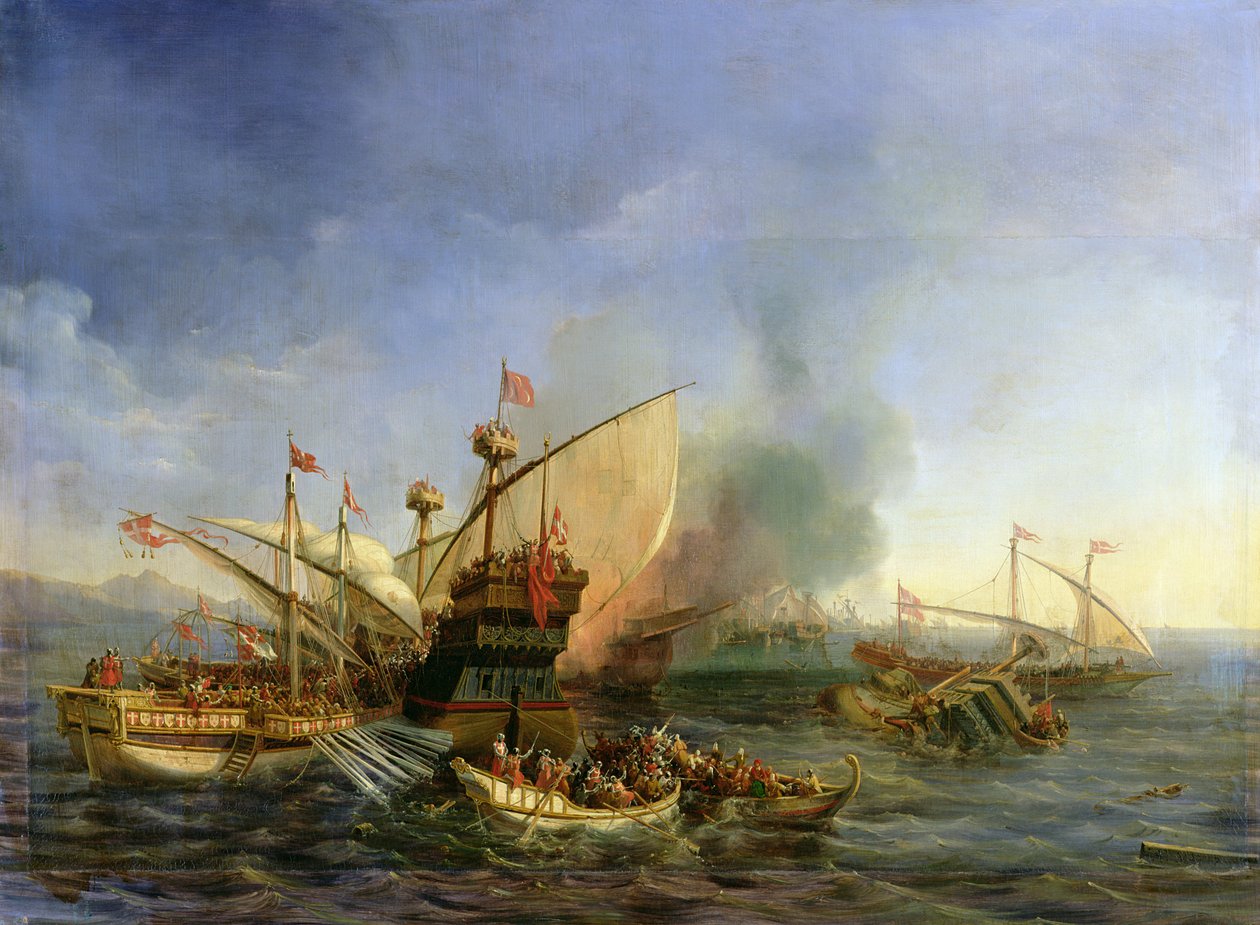
"The Shield of Defence of the Christians": King Martino Zaccaria at the Battle of Chios (1319) & Smyrna (1344)
Following the collapse of Byzantine naval power in western Anatolia in the late thirteenth century, the defense of the Christian Aegean fell largely upon two maritime powers: the Zaccaria Lords of Chios and Phocaea, and the Knights Hospitaller of Rhodes. In July 1319, when Emir Mehmed Beg of the Aydinid Emirate set out from Ephesus with a fleet of twenty-eight vessels to subdue Chios, he was intercepted off the island's shores by Martino Zaccaria and the Hospitaller commander Albert of Schwarzburg.
Bolstering the Hospitaller squadron with his own galleys and troops, Martino helped deliver a crushing Christian victory in which only six Turkish vessels escaped capture or destruction. Referring to the rule of Martino and his brother in Chios, the historian William Miller wrote in Essays on the Latin Orient:
"One contemporary writer after another praises their services to Christendom, and describes the terror with which they filled the Turks. The Infidels, we are told, were afraid to approach within twelve miles of Chios, because of the Zaccaria, who always kept a thousand foot-soldiers, a hundred horsemen, and a couple of galleys ready for every emergency. Had it not been for the valour of the Genoese lords of Chios 'neither man, nor woman, nor dog, nor cat, nor any live animal could have remained in any of the neighbouring islands.' Not only were the brothers 'the shield of defence of the Christians,' but they did all they could to stop the infamous traffic in slaves... In one year alone he captured 18 Turkish pirate ships, and at the end of his reign he had slain or taken more than 10,000 Turks."
Due to this legendary reputation—which earned him the 1325 Imperial grant as King and Despot of Asia Minor—Pope Clement VI appointed Martino to command the Papal galleys during the Smyrniote Crusade of 1344 alongside the Knights Hospitaller. Following their naval triumph at the Battle of Pallene and the capture of the port and lower city of Smyrna, King Martino met a martyr's death on 17 January 1345 during an ambush led by Umur Bey at the former cathedral of Smyrna.

Heirlooms of Byzantium: The Palaiologan Double-Headed Eagle Silver Service
Among the private familial heirlooms preserved across the centuries by our House is an antique silver service bearing a motif deeply tied to our history between the thirteenth and fifteenth centuries: the imperial double-headed eagle of the Palaiologos dynasty.
Crucially, the eagle engraved upon each piece matches the older late-Byzantine heraldic style in use when the Palaiologoi reigned in Constantinople and Mystras, rather than later modern adaptations. The presence of this specific imperial emblem upon personal domestic silver testifies to our ancestors' unbroken consciousness of their maternal imperial origins—harkening back to the era when the Palaiologos and Asen names were borne directly alongside our own through repeated imperial marriages spanning from Michael VIII to the generation of Constantine XI.

The Castle of Chios & the Gothic Mint of Kamenos Pyrgos
From 1304 to 1329, the sovereign administration of Chios under Benedetto I, Benedetto II Palaiologo-Zaccaria, and King Martino I rested upon two architectural pillars: the formidable coastal Castle of Chios, which regulated maritime traffic between the Mediterranean and the Black Sea, and the personal dynastic estate of Kamenos Pyrgos ("Burnt Tower") in the Kampos district, which housed the Zaccaria mint.
At the Castle of Chios—originally constructed by the Byzantines in the tenth century and today one of the oldest continuously inhabited citadels in Europe—Benedetto I and his grandsons heavily fortified the sea walls and erected defensive towers to shield the island from Turkish raids. Ironically, these unauthorized fortifications served as the diplomatic pretext for Emperor Andronikos III Palaiologos, wary of his cousin Martino's growing wealth and royal title, to assemble an imperial fleet in 1329 to reclaim the island.
On the periphery of the capital, extending as far as the Parthenis stream, stood the personal Zaccaria fief of Kamenos Pyrgos—an estate of palaces, towers, and abundant water that remains the finest surviving example of Gothic architecture on Chios today, adjacent to land still retained by the Damalas family. To support the rapid expansion of Chian mastic and alum trade as far as Flanders, the Zaccaria established their sovereign mint within the principal Gothic edifice of Kamenos Pyrgos, striking gold and silver coinage bearing the Zaccaria arms that circulated alongside Byzantine hyperpyra, Florentine florins, and Venetian ducats.

The Hospitaller Order of St. James of Andravida & the 1404 Allodial Consolidation of Achaea
Established around 1209 in Andravida, the capital of the Principality of Achaea, by Prince Geoffrey I of Villehardouin, the Order of St. James of Andravida served as an indigenous crusader military-hospitaller institution defending the Frankish Peloponnese against external incursions whilst caring for the sick and poor across its local commanderies.
Following early efforts by the Villehardouin princes to affiliate the Hospital of St. James first with the Teutonic Knights (1246) and subsequently with the Knights Templar (c. 1251), the dissolution of the Templars in 1312 placed the properties and operations of St. James under the administration of the Knights Hospitaller of St. John well into the fifteenth century.
Throughout this final century of Frankish rule in the Peloponnese, the Zaccaria dynasty maintained close ties with the chivalric orders in the Morea. Following the regency and rule of Princess Maria II Zaccaria in 1402—the last female ruler in Latin Greece—her nephew, Prince Centurione II Asen Zaccaria, purchased the full sovereign rights to the Principality of Achaea from King Ladislaus of Naples in 1404. That historic transaction severed feudal subordination to Naples for the first time since the 1267 Treaty of Viterbo, transforming the Principality into an independent, allodial sovereign realm and uniting the Achaean princely and chivalric heritage within the Zaccaria majorat.